
A Complete Guide for Food & Beverage Manufacturers, R&D Teams, and Ingredient Buyers
Natural Red Food Color Solutions for Clean Label Food & Beverage Applications
The global food industry is undergoing a rapid transformation toward clean label, plant-based, and synthetic dye-free formulations. Among all color categories, natural red food colors represent one of the fastest-growing segments due to increasing regulatory pressure and consumer concerns over artificial dyes such as Red 40 (Allura Red AC).
Food and beverage brands are actively replacing synthetic red dyes with plant-based natural red colorants derived from fruits, vegetables, and botanical sources. These natural alternatives deliver attractive red shades while meeting clean-label and regulatory expectations.
Commonly used natural red food color ingredients include:
- Anthocyanin-based colors (grape skin, black rice, purple sweet potato, etc.)
- Betalain-based colors (beet red / beetroot extract)
These ingredients offer a wide color spectrum from bright red to purple-red and bluish-red, making them suitable for beverages, gummies, dairy products, confectionery, and plant-based foods.
Market Trend – Shift from Synthetic Red Dye to Natural Red Food Color
The global demand for natural food coloring solutions is driven by several key factors:
1. Clean Label Demand
Consumers increasingly prefer:
- “No artificial colors”
- “Plant-based ingredients”
- “Naturally colored food products”
2. Regulatory Pressure on Synthetic Dyes
Synthetic dyes like Red 40 are under scrutiny in multiple markets, especially in children’s food categories.
3. Growth of Plant-Based Food Industry
The expansion of:
- Vegan foods
- Functional beverages
- Plant-based dairy alternatives
has significantly increased demand for natural red pigments.
4. Technological Improvements in Natural Color Stability
Modern extraction and stabilization technologies have improved the features of natural colors:
- Heat resistance
- Light stability
- Application versatility
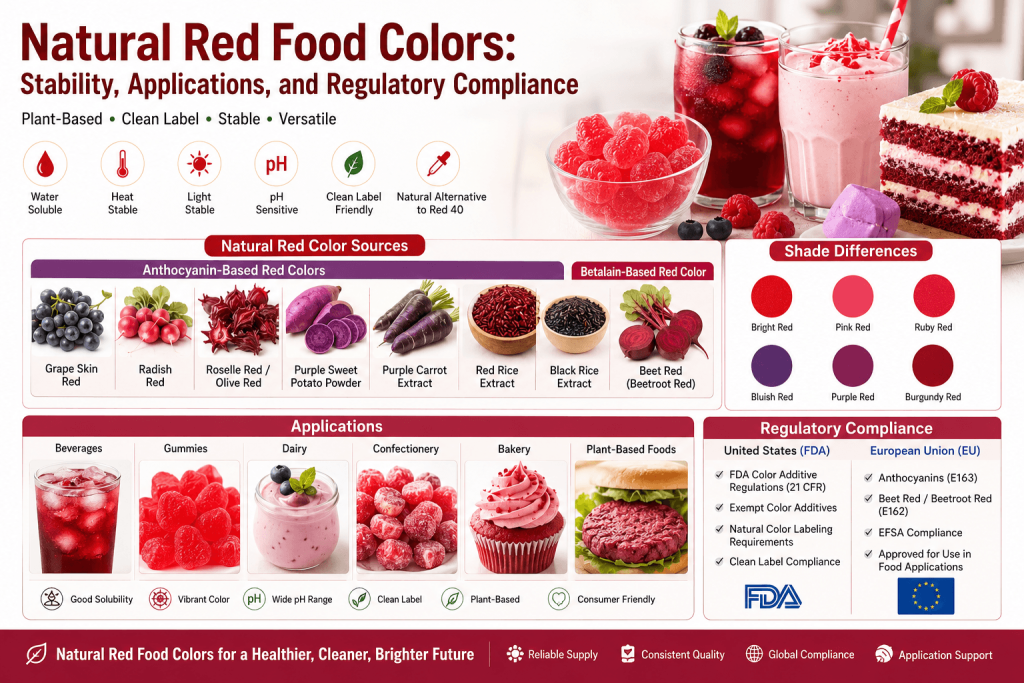
Key Functional Properties of Natural Red Food Colors
Water Solubility
Most natural red food colorants are water-soluble, especially:
- Anthocyanins
- Beet red (betalains)
This makes them ideal for:
- Beverages
- Gummies
- Syrups
- Dairy systems
Heat Stability
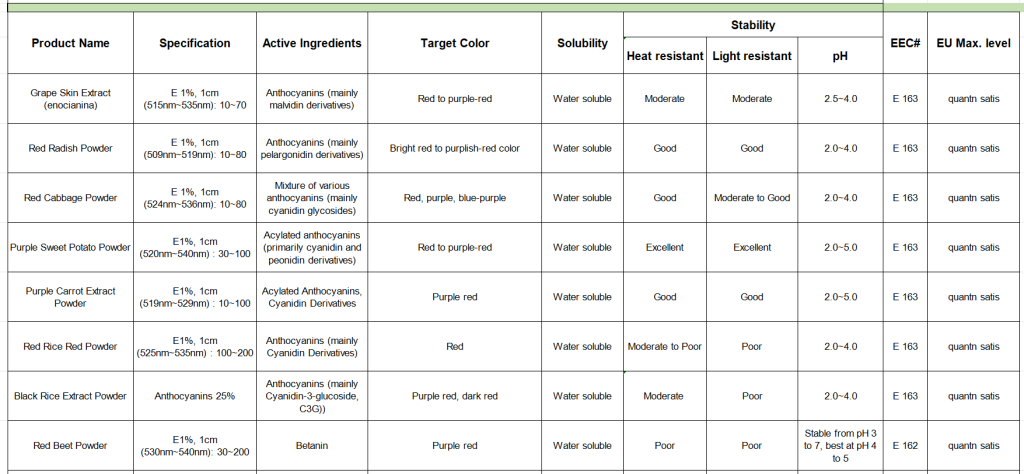
Heat resistance varies significantly among natural red pigments:
- High stability: Beet red (E162), purple sweet potato
- Medium stability: red radish, red rice
- Lower stability: grape skin anthocyanins, black rice extract
High-temperature processes (gummy cooking, baking, pasteurization) may cause color degradation.
Light Stability
Light exposure impacts long-term product color:
- Beet red: moderate stability
- Anthocyanins: light-sensitive
- Purple carrot: relatively improved stability in some systems
Opaque packaging is often recommended for sensitive formulations.
pH Stability and Color Shift Behavior
pH is the most critical factor influencing natural red color performance:
- pH < 3: bright red / ruby red
- pH 3–5: red to purple-red
- pH > 5: bluish-red, purple, or fading
Anthocyanins are highly pH-sensitive, while beet red shows broader pH tolerance.
Clean Label Advantage
Natural red pigments are widely used as:
- Natural alternative to Red 40
- “Fruit/vegetable color”
- “Plant-based colorant”
- “Non-synthetic food coloring”
This supports strong consumer-friendly labeling strategies.
Types of Natural Red Food Colors and Product Comparison
Anthocyanin-Based Natural Red Colors
Anthocyanins are the largest category of plant-based red pigments.
Sources include:
- Grape skin red (grape skin extract color)
- Radish red
- Roselle red
- Purple sweet potato color
- Purple carrot extract
- Red rice extract
- Black rice extract
Key characteristics:
- Highly pH-sensitive
- Wide color range (red → purple → bluish-red)
- Strong branding as “fruit & vegetable derived”
Betalain-Based Natural Red Color
Beet Red (Beetroot Red / E162)
Beet red is derived from beetroot and contains betalain pigments (betanin).
Key characteristics:
- Bright pink-red to red shade
- Better pH stability than anthocyanins
- Strong performance in beverages and gummies
- Clean-label positioning as vegetable-derived color
Technical Comparison of Natural Red Food Pigments
Natural Red Shade Spectrum in Food Applications
Natural red food colors are not limited to a single hue. They create a wide visual palette:
- Bright red: Beet red, red radish extract
- Pink red: beet betalain systems
- Ruby red: grape skin anthocyanins (acidic systems)
- Bluish red: black rice extract, grape anthocyanins (neutral pH)
- Purple red: purple sweet potato, purple carrot
- Burgundy red: red rice extract blends
Final shade depends on:
- pH system
- Concentration
- Co-pigmentation
- Processing conditions
Application Performance in Food & Beverage Systems
Natural Red Colors in Beverages
Key requirements:
- High water solubility
- Acid stability
- Clean red appearance
Best options:
- Anthocyanins (grape skin, black rice)
- Beet red (E162)
Applications:
- Juices
- Functional drinks
- Carbonated beverages
- Tea-based drinks
Natural Red Colors in Gummies
Key requirements:
- Heat stability
- Sugar/acid resistance
- Color retention during storage
Best options:
- Beet red (E162)
- Purple sweet potato color
Dairy Applications
Challenges:
- Protein interaction
- pH variation
- Light exposure
Best choices:
- Beet red
- Stabilized anthocyanin systems
Confectionery & Bakery
- Gummies: beet red, sweet potato color
- Hard candies: beet red with stabilization
- Bakery: limited use due to heat degradation
Plant-Based Foods
Used in:
- Vegan yogurt
- Plant-based desserts
- Functional nutrition products
Regulatory Compliance – FDA & EU Natural Red Food Colors
United States FDA Regulations
In the United States, natural food colors are regulated under FDA color additive regulations (21 CFR).
Key compliance pathways:
1. FDA Color Additive Regulations
- Color additives must be approved for intended use
- Compliance depends on product category
2. Exempt Color Additives
Some plant-derived colors may be considered:
- “Color additives exempt from certification”
- Derived from edible fruits/vegetables
3. Labeling Requirements
- Must comply with ingredient declaration rules
- “Colored with vegetable juice” or similar labeling may apply
4. Clean Label Compliance
Strong demand for:
- “No artificial colors”
- “Naturally colored”
European Union Regulations
Anthocyanins – E163
- Approved food color additive
- Derived from fruits, vegetables, cereals
- Used under Regulation (EC) No 1333/2008
Beet Red – E162
- Beetroot-derived color
- Approved EU additive
- Subject to purity criteria under Regulation (EU) No 231/2012
EFSA Compliance
All natural red colors must comply with:
- Safety evaluation by EFSA
- Defined usage conditions in food categories
How to Choose the Right Natural Red Food Color for Your Application
Selecting the right natural red food color ingredient requires a systematic formulation approach:
1. Based on pH System
- Acidic beverages → anthocyanins, beet red
- Neutral systems → beet red preferred
2. Based on Processing Temperature
- High heat → beet red, purple sweet potato
- Low heat → anthocyanins
3. Based on Desired Shade
- Bright red → beet red
- Purple-red → anthocyanins
- Bluish-red → black rice / grape skin
4. Based on Product Type
- Beverages → anthocyanins, beet red
- Gummies → beet red, sweet potato color
- Dairy → beet red preferred
5. Based on Stability Requirements
- Light stability needed → beet red preferred
- Shelf-life stability → stabilized systems
6. Cost & Performance Balance
- Beet red: cost-effective, stable
- Anthocyanins: premium positioning, wider branding appeal
FAQ – Natural Red Food Colors
Q1: What is the best natural alternative to Red 40?
Beet red (E162) and anthocyanins are the most widely used natural alternatives to Red 40.
Q2: Which natural red color is best for beverages?
Anthocyanins (grape skin, black rice) and beet red are most suitable for beverages.
Q3: Which natural red color is most stable under heat?
Beet red and purple sweet potato color show the best heat stability.
Q4: Are natural red food colors stable in gummies?
Yes, beet red and stabilized anthocyanin systems are commonly used in gummy applications.
Q5: Do natural red colors change with pH?
Yes, especially anthocyanins, which change from red to purple depending on pH.
Conclusion – Reliable Natural Red Food Color Manufacturer & Supplier
The demand for natural red food colors continues to grow rapidly across global food and beverage markets. Understanding the differences between anthocyanins, beet red (E162), and other plant-based pigments is essential for successful product formulation.
As a professional natural food color manufacturer and supplier, we provide:
- Stable plant-based red color solutions
- Application support for beverages, gummies, and dairy
- Regulatory-compliant ingredients for global markets
- Clean-label natural alternatives to synthetic dyes
Looking for high-quality natural red food color ingredients for your formulation?
Contact us for:
- Technical datasheets (TDS)
- Samples for beverage & gummy testing
- Customized color solutions for your application