
Fudan Team’s New Discovery: Akkermansia muciniphila Improves Alzheimer’s Disease via the Gut-Brain Axis
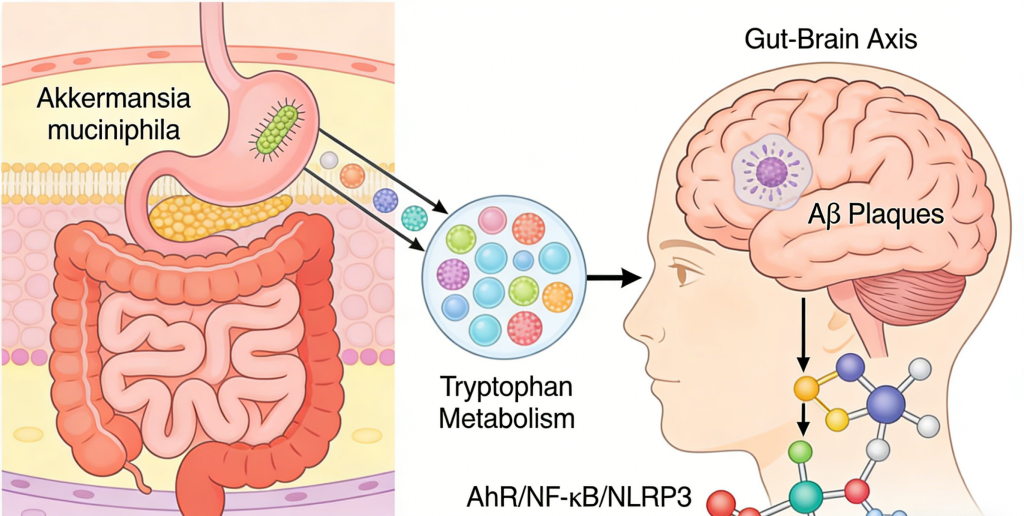
In recent days, a research team led by Professor Liang Chunmin from the School of Basic Medical Sciences, Fudan University, in collaboration with multiple research institutions, has published a groundbreaking study in the Q1 journal Alzheimer’s Research & Therapy. The core finding: Akkermansia muciniphila significantly improves cognitive deficits and reduces amyloid-beta (Aβ) deposition in the brain of APP/PS1 transgenic Alzheimer’s disease (AD) model mice by regulating tryptophan metabolism.
This is not the first time Akkermansia muciniphila has made its mark in the field of AD research. As early as 2020, a breakthrough report published in a Nature sub-journal revealed that Akkermansia muciniphila intervention could reduce Aβ plaque deposition and Aβ levels in the brains of APP/PS1 (Alzheimer’s disease) model mice, while also improving cognitive deficits. In that study, APP/PS1 mice were divided into a normal diet group and a high-fat diet group, and treated with gavage for 6 months. The results confirmed that Akkermansia muciniphila improved glucose metabolism, intestinal barrier function, and lipid metabolism in the AD mouse model.
However, this new study digs deeper into the underlying mechanism—not just a simple “healthy gut, healthy brain” correlation, but a precise molecular pathway that connects the gut microbiome to brain health.
Entitled Akkermansia muciniphila reduces neuroinflammation and Aβ deposition via tryptophan metabolism in the APP/PS1 mouse model of Alzheimer’s disease, the research was officially published on February 19, 2026, in the Q1 academic journal Alzheimer’s Research & Therapy. It provides a brand-new perspective for exploring the role of the gut microbiome-gut-brain axis in Alzheimer’s disease.
Alzheimer’s Disease and the Gut-Brain Axis: A Critical Connection
Alzheimer’s disease is a progressive neurodegenerative disorder, with key pathological features including Aβ deposition, neuroinflammation, and cognitive impairment. In recent years, a growing body of evidence has shown that intestinal flora dysbiosis is closely associated with the occurrence and development of Alzheimer’s disease.
The pathological chain of AD and gut dysbiosis is clear: Intestinal flora dysbiosis → increased LPS (lipopolysaccharide) → impaired intestinal barrier → exacerbated peripheral inflammation → damage to the blood-brain barrier. Recent studies have found that AD patients not only have Aβ deposition in the brain but also often experience decreased intestinal flora diversity, increased pro-inflammatory bacteria, and elevated intestinal barrier permeability. Intestinal-derived inflammatory factors can cross the blood-brain barrier, affect the central immune state, and continuously amplify neuroinflammation—providing crucial context for the gut-brain axis’s role in AD progression.
Akkermansia muciniphila: A Promising Probiotic for Brain Health
Akkermansia muciniphila, a next-generation beneficial microorganism, has been proven to have potential effects in improving inflammatory conditions, cognitive deficits, and amyotrophic lateral sclerosis (ALS). However, its specific mechanism of action in Alzheimer’s disease—especially its role in the microbiome-gut-brain axis—has remained incompletely understood until now. This study confirms that Akkermansia muciniphila is a promising new approach to preventing the progression of Alzheimer’s disease through the gut microbiome-brain axis, as a single probiotic strain for AD intervention.
How Does Akkermansia muciniphila “Rescue the Brain from Afar”?
Through a series of experiments, the Fudan team revealed the potential mechanisms by which Akkermansia muciniphila improves Alzheimer’s disease symptoms:
- Improve Cognitive Function and Reduce Aβ Deposition: After supplementing APP/PS1 Alzheimer’s model mice with Akkermansia muciniphila, the mice’s cognitive deficits were significantly improved, and Aβ deposition in the brain was markedly reduced.
- Reshape the Intestinal Microecology: Akkermansia muciniphila not only colonizes the gut itself but also drives an overall “reshuffling” of the intestinal flora—increasing beneficial bacteria, inhibiting pro-inflammatory bacteria, and optimizing the microecological environment.
- Regulate Metabolites: Metabolomic analysis of mouse intestinal contents showed that supplementation with Akkermansia muciniphila significantly increased 62 metabolites in the gut, including: These metabolites are positively correlated with cognitive function indicators, acting as the “secret weapons” of Akkermansia muciniphila.
- ↑ Indole-3-acetic acid (IAA) — a tryptophan metabolite and core neuroprotective molecule
- ↑ Short-chain fatty acids (butyric acid, acetic acid) — repair the intestinal barrier and reduce inflammation
- ↑ Tryptophan itself — a precursor for the synthesis of the neurotransmitter 5-HT (serotonin)
- Regulate Peripheral Inflammation: Akkermansia muciniphila reduces pro-inflammatory factors such as IL-6, IL-1β, and TNF-α in the plasma, while increasing anti-inflammatory factors such as IL-4, IL-10, and IL-22—protecting the brain from the “source of inflammation.”
- Comparable to Drug Efficacy: In the study, the NLRP3-specific inhibitor MCC950 was used as a positive control. It was found that the anti-inflammatory effect of Akkermansia muciniphila was equivalent to that of the drug, but safer and more natural.
- Reveal Key Signaling Pathways: Akkermansia muciniphila directly inhibits the excessive activation of microglia through the AhR/NF-κB/NLRP3 signaling pathway. Microglia are the “immune cells” of the brain; under normal conditions, they protect neurons, but when overactivated, they release inflammatory factors and exacerbate Aβ deposition. Among them, IAA, a key tryptophan metabolite produced by Akkermansia muciniphila, acts like a “key” to activate the AhR receptor, turn off the NLRP3 “inflammation switch,” and return microglia to their “protective mode.”
Research Significance: A New Hope for Alzheimer’s Intervention
This study is the first to systematically clarify the mechanism by which Akkermansia muciniphila exerts neuroprotective effects in AD model mice by regulating tryptophan metabolism and its downstream AhR/NF-κB/NLRP3 signaling pathway. It not only provides clearer biological evidence for the involvement of the gut-brain axis in neurodegenerative diseases but also reaffirms the key role of Akkermansia muciniphila in maintaining barrier homeostasis, regulating immune balance, and improving the metabolic environment.
Aging-related cognitive decline may not be an independent event within the brain, but a result of imbalances in the body’s overall metabolic and immune networks. By regulating the intestinal microecology—especially key strains with clear functions and mechanisms, such as Akkermansia muciniphila—we may have a new intervention strategy to delay neuroinflammation and cognitive decline in the future.
Interested in Akkermansia muciniphila for Your Research or Product Development?
As a cutting-edge probiotic with proven potential in brain health and neurodegenerative disease intervention, Akkermansia muciniphila opens up new possibilities for pharmaceutical, nutraceutical, and research applications. Whether you are conducting academic research, developing functional products, or seeking high-quality probiotic strains, our team is here to provide professional support and customized solutions.
Contact us today to learn more about Akkermansia muciniphila, our research partnerships, and product customization services. Let’s work together to turn this scientific breakthrough into practical solutions for brain health!
To get detailed data of Akkermansia muciniphila research or customized strain solutions, contact us via the following ways
Contact Us:
Email: lisa@nihaobio.com
Website: https://nihaobio.com/
For customized solutions, feel free to reach out directly.