
Over the past decade, the global sweetener industry has undergone a major transformation. In the early years, the market was largely dominated by artificial sweeteners such as Aspartame, Acesulfame Potassium, and Sucralose due to their strong sweetness intensity, formulation stability, and cost advantages.
However, consumer preferences are changing rapidly.
Driven by the global trends of “clean label,” “plant-based,” “sugar reduction,” and “better-for-you nutrition,” natural sweeteners are now becoming the core direction for new product development across beverages, functional foods, dietary supplements, dairy products, confectionery, and nutraceuticals.
Today, major international brands are actively reformulating products to reduce sugar content while maintaining a sugar-like taste experience. As a result, ingredients such as Allulose, Monk Fruit Extract, and high-purity Steviol Glycosides are experiencing explosive growth in North America, Europe, and Asia-Pacific markets.
This guide provides a practical overview of the world’s mainstream sweeteners in 2026, including natural sweeteners, artificial sweeteners, CAS numbers, applications, and future market trends. It can also serve as a useful B2B reference for ingredient suppliers, formulators, and sales teams.
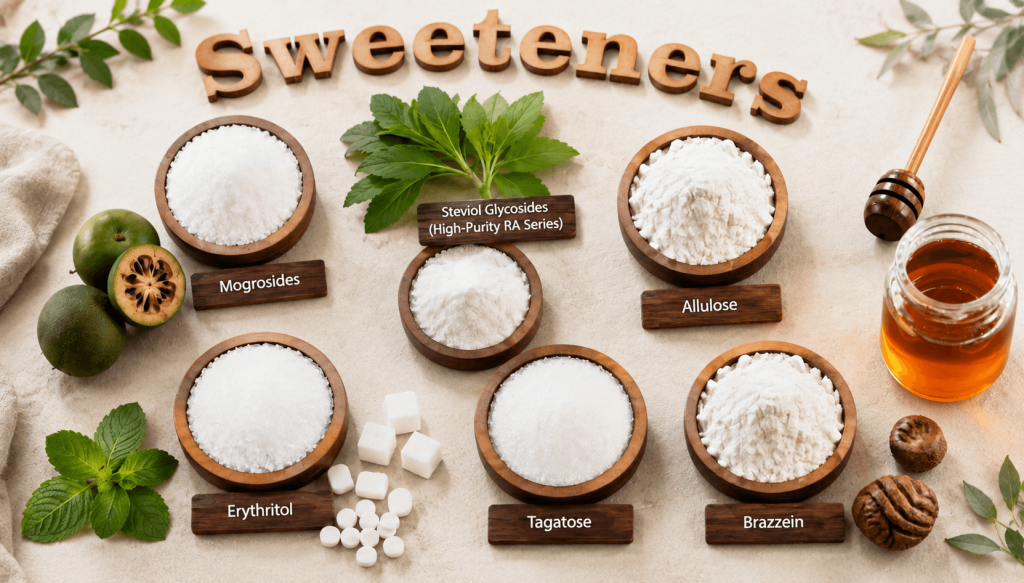
Fastest Growing Natural Sweeteners in 2026
Natural sweeteners are expected to continue outperforming synthetic sweeteners in premium food and beverage applications. The biggest drivers are regulatory acceptance, consumer trust, and improved taste technology.
1. Allulose — The Fastest Growing Rare Sugar
CAS: 551-68-8
Source: Fructose isomerization
Applications: Beverages, ice cream, dairy, nutrition products
Allulose has become one of the hottest sweeteners in the United States market. It delivers a taste profile very close to sucrose, with extremely low calories and good FDA positioning for reduced-sugar labeling.
Compared with traditional polyols, Allulose provides:
- Better mouthfeel
- Lower cooling effect
- Excellent beverage performance
- Sugar-like browning in bakery systems
Large beverage companies are increasingly using Allulose in zero-sugar and functional drink formulations.
2. Monk Fruit Extract — Clean Label Star Ingredient
CAS: 88901-36-4
Main Component: Mogroside V 25%–60%
Applications: Functional beverages, syrups, supplements
Monk Fruit is rapidly expanding in both North America and Europe due to its strong clean-label positioning.
Unlike artificial sweeteners, Monk Fruit is perceived as:
- Plant-based
- Natural
- Consumer-friendly
- Suitable for premium wellness products
Many brands combine Monk Fruit (Luohanguo) with Erythritol or Stevia to improve sweetness balance and reduce aftertaste.
3. Steviol Glycosides — Still the Global Mainstream
CAS: 57817-89-7
Applications: Beverages, sports nutrition, gummies, tablets
Stevia remains one of the most widely used natural sweeteners globally. However, the market is shifting from traditional RA60/RA80 grades toward high-purity Reb M and Reb D systems.
Why Reb M Is Growing Fast
Reb M offers:
- Cleaner sweetness
- Reduced bitterness
- Taste closer to sugar
- Better compatibility with modern beverage systems
As fermentation technology improves, Reb M production costs are expected to decrease significantly over the next several years.
4. Erythritol — Core Bulk Sweetener
CAS: 149-32-6
Applications: Sugar-free candy, tablets, beverages, bakery
Erythritol remains one of the most important bulk sweeteners in sugar-free systems because it provides:
- Very low calories
- Excellent digestive tolerance
- Good stability
- Synergy with high-intensity sweeteners
Although market competition has intensified, Erythritol is still a foundational ingredient in most sugar-reduction formulations.
5. Tagatose — Emerging Low-GI Opportunity
CAS: 87-81-0
Applications: Dairy, chocolate, bakery
Tagatose is gaining attention because of its:
- Low glycemic index
- Sugar-like taste
- Heat stability
- Good digestive profile
It is increasingly used in premium diabetic-friendly and metabolic health products.
Other Important Natural Sweeteners
Several other sweetening ingredients continue to play important roles in formulation systems:
| Ingredient | CAS | Main Applications |
| Xylitol | 87-99-0 | Gum, toothpaste, candies |
| Maltitol | 585-88-6 | Chocolate, confectionery |
| Sorbitol | 50-70-4 | Syrups, humectants |
| Isomalt | 64519-82-0 | Hard candy |
| Trehalose | 6138-23-4 | Bakery, frozen foods |
| Inulin | 9005-80-5 | Prebiotic sweetening systems |
| Fructooligosaccharides | 308066-66-2 | Dairy, beverages |
| Thaumatin | 53850-34-3 | Flavor modulation |
Artificial Sweeteners Still Hold Strong Market Advantages
Despite the rapid growth of natural sweeteners, artificial sweeteners still maintain strong market share because of:
Low formulation cost
High sweetness intensity
Excellent heat stability
Mature global supply chains
The most widely used synthetic sweeteners in 2026 include:
| Ingredient | CAS | Main Applications |
| Sucralose | 56038-13-2 | Beverages, bakery |
| Aspartame | 22839-47-0 | Soft drinks |
| Acesulfame Potassium | 55589-62-3 | Sweetener blends |
| Saccharin Sodium | 6155-57-3 | Beverages, pickles |
| Sodium Cyclamate | 139-05-9 | Tabletop sweeteners |
| Neotame | 165450-17-9 | High-intensity sweetening |
| Advantame | 714229-20-6 | Ultra-high sweetness systems |
| NHDC | 20702-77-6 | Bitter masking |
In many cost-sensitive beverage applications, blends of Sucralose + Ace-K remain highly competitive.
Future Sweetener Trends: What Will Dominate Beyond 2026?
Precision Fermentation Sweet Proteins
One of the biggest future opportunities may come from sweet proteins such as:
Brazzein
Thaumatin
These ingredients are attracting significant attention because they can potentially deliver:
Sugar-like sweetness
Very low usage levels
Better flavor performance
Natural positioning
As precision fermentation technology scales commercially, sweet proteins may become the next major breakthrough in the sugar reduction industry.
Brazzein is emerging as one of the most promising next-generation natural sweeteners in the global sugar reduction market. Derived from the West African plant *Pentadiplandra brazzeana*, Brazzein is a heat-stable sweet protein with extremely high sweetness intensity and a taste profile closer to sucrose compared with many traditional high-intensity sweeteners.
Unlike artificial sweeteners, Brazzein supports clean-label and plant-based product positioning, making it highly attractive for beverages, dairy, functional nutrition, and healthy snacks. With the rapid development of precision fermentation technology, commercial production of Brazzein is becoming increasingly feasible. Industry experts believe Brazzein may become a key future alternative to sugar, stevia, and synthetic sweeteners in premium food and beverage applications.
Hybrid Sweetener Systems
Instead of relying on a single sweetener, modern formulations increasingly use blended systems such as:
Allulose + Monk Fruit
Reb M + Erythritol
Sucralose + Ace-K
Inulin + Stevia
These combinations help improve:
Taste profile
Cost efficiency
Mouthfeel
Stability
Sugar Reduction Is Becoming a Global Standard
Governments worldwide continue introducing sugar taxes and stricter nutrition regulations. As a result, reducing sugar is no longer only a marketing strategy — it is becoming a long-term industry requirement.
In the next several years, the global sweetener market will likely focus on:
Natural positioning
Better taste performance
Functional nutrition
Clean label claims
Precision fermentation technology
For B2B ingredient suppliers, understanding these trends is essential for developing future business opportunities in beverages, supplements, dairy, confectionery, and functional foods.