
In the global clean-label transformation of the food industry, manufacturers are actively replacing synthetic food colorants with natural alternatives that offer both functionality and consumer appeal. Among these, Beta-Carotene has emerged as one of the most widely adopted solutions across beverage, dairy, confectionery, bakery, and nutraceutical applications.
This article provides a comprehensive overview of market trends, formulation technologies, and regulatory compliance under China’s GB 2760-2024 standard, helping food manufacturers understand how Beta-Carotene supports modern product development.
1. Market Overview: Why Beta-Carotene Is Replacing Synthetic Food Colorants
As clean-label demand continues to accelerate globally, traditional synthetic dyes such as Sunset Yellow and Tartrazine are gradually losing market share in mainstream food applications.
In contrast, Beta-Carotene is increasingly preferred by global brands due to its dual functionality:
Natural coloring performance
Nutritional enrichment capability
Key Market Drivers
The rapid adoption of Beta-Carotene is driven by several structural trends in the food industry:
Rising demand for clean-label and transparent ingredient lists
Growth of plant-based and vegan food categories
Increasing consumer awareness of artificial additive risks
Global sugar and additive reduction initiatives
Reformulation of legacy products into “natural” versions
As a result, Beta-Carotene has become a core ingredient in global reformulation projects across major food and beverage companies.
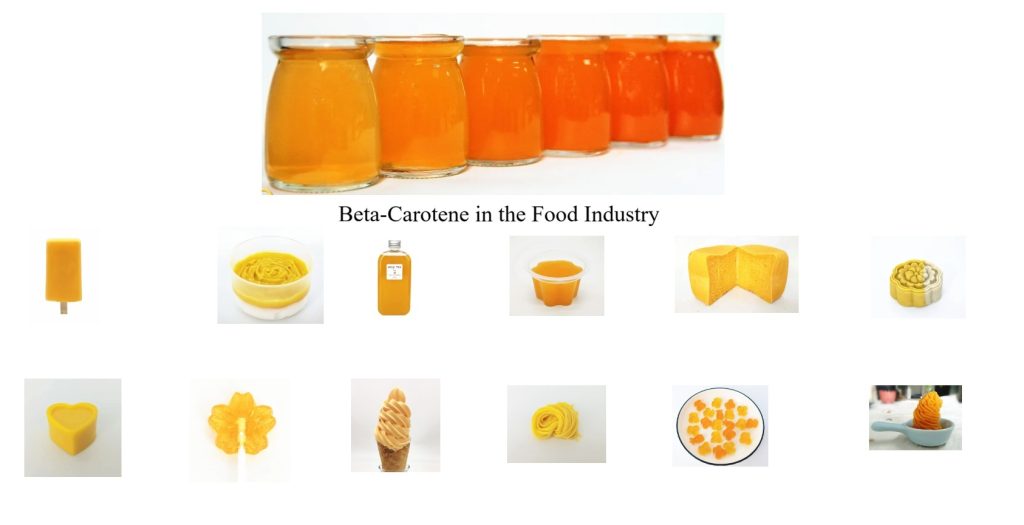
2. Beta-Carotene Benefits in Food Formulation
2.1 Visual Performance
Beta-Carotene delivers a stable color spectrum ranging from golden-yellow to deep orange. This makes it highly suitable for improving product appearance and enhancing perceived flavor intensity.
Compared with synthetic colorants, it provides:
More natural color perception
Better consumer acceptance
Stable tone across different food matrices
2.2 Nutritional Functionality
As a provitamin A carotenoid, Beta-Carotene contributes additional nutritional value beyond coloring functionality.
It supports:
Vitamin A enrichment claims
Functional food positioning
Wellness-oriented product development
Clean-label marketing strategies
This dual functionality significantly increases its commercial value in premium food applications.
3. Technical Innovations: Oil-Soluble vs Water-Dispersible Beta-Carotene
3.1 Oil-Soluble Beta-Carotene (Fat Systems)
Naturally, Beta-Carotene is lipophilic and performs best in oil-based systems.
Typical applications include:
Margarine and spreads
Chocolate and cocoa butter systems
Bakery fats and fillings
Oil-based capsules and soft gels
In these systems, Beta-Carotene offers excellent dispersion, heat stability, and resistance to oxidation when properly formulated.
3.2 Microencapsulated Water-Dispersible Beta-Carotene (CWD Technology)
To expand its application range, modern processing uses microencapsulation technology to convert Beta-Carotene into cold-water dispersible (CWD) powder.
This innovation enables use in:
Clear beverages and functional drinks
Gummies and jellies
Low-fat dairy systems
Instant powder mixes
Microencapsulation significantly improves stability against light, oxygen, and pH variations, making it suitable for modern beverage systems.
4. Regulatory Compliance: GB 2760-2024 Food Additive Standard
Under China’s updated national food safety regulation GB 2760-2024, Beta-Carotene is approved for use across a wide range of food categories with defined dosage limits.
Approved Application Categories Include:
Dairy products (milk, yogurt, cheese analogs)
Confectionery and candies
Chocolate and cocoa products
Bakery goods and baked snacks
Fruit-based beverages and juices
Jelly products
Meat products and processed foods
Seasonings and solid compound spices
Grain-based fillings
Puffed and extruded snacks
This broad regulatory approval strengthens Beta-Carotene’s position as a globally compliant colorant for export-oriented food manufacturers.
5. Industrial Applications & Case Studies
5.1 Bakery Products (High-Temperature Stability)
Beta-Carotene demonstrates excellent thermal stability in baked applications such as breads, cakes, biscuits, and mooncakes. It remains stable under baking conditions up to 200°C, maintaining consistent color without degradation.
5.2 Confectionery Applications
In confectionery systems including hard candies, gummies, and chocolate products, Beta-Carotene provides:
Transparent and uniform coloration
No crystallization or sedimentation
Strong compatibility with sugar and fat matrices
5.3 Traditional Pastries & Fillings
In mochi, jams, and sweet fillings, Beta-Carotene ensures color consistency throughout shelf life while preventing migration or uneven fading.
5.4 Beverages & Jellies
Microencapsulated Beta-Carotene systems are widely used in acidic beverages and jelly products, providing:
Acid stability
No oil separation or “ring formation”
Long-term color stability under storage conditions
5.5 Frozen Desserts
In ice cream, popsicles, and frozen dairy desserts, Beta-Carotene maintains color integrity even under freezing and thawing cycles, preventing discoloration or phase separation.
5.6 Convenience Foods & Snacks
Beta-Carotene is widely used in instant noodles, puffed snacks, and seasoning blends, providing a natural golden-orange appearance that enhances product attractiveness and perceived flavor intensity.
6. Conclusion: Beta-Carotene as a Core Ingredient in Clean-Label Reformulation
Beta-Carotene is no longer simply a coloring agent. It has evolved into a multifunctional ingredient that supports modern food innovation strategies, combining visual enhancement with nutritional value.
By selecting the appropriate form—oil-soluble or microencapsulated CWD—manufacturers can optimize performance across different food systems while ensuring compliance with GB 2760-2024 and meeting global clean-label expectations.
Quick Formulation Guide for Engineers
Oil-based systems: Crystalline Beta-Carotene (ideal for bakery fats, chocolate, spreads)
Water-based systems: CWD microencapsulated Beta-Carotene (ideal for beverages, gummies, jellies)