
What Is Sorbitol Syrup 70%?
Sorbitol Syrup 70% is a clear, water-soluble polyol widely used in food, dietary supplements, pharmaceuticals, and personal care products. It provides mild sweetness, excellent moisture retention, anti-crystallization properties, and bulk replacement functionality, making it one of the most versatile ingredients in modern formulations.
Compared with sucrose, Sorbitol Syrup 70% offers lower caloric value, better humectancy, and improved product stability. It is especially popular in sugar-free and reduced-sugar formulations where texture, shelf life, and processing performance are critical.
Product Name: Sorbitol Syrup 70%
Other names: Sorbitol liquid, Sorbitol Solution, D-Glucitol; Sorbol; D-Sorbitol;
CAS Number: 50-70-4
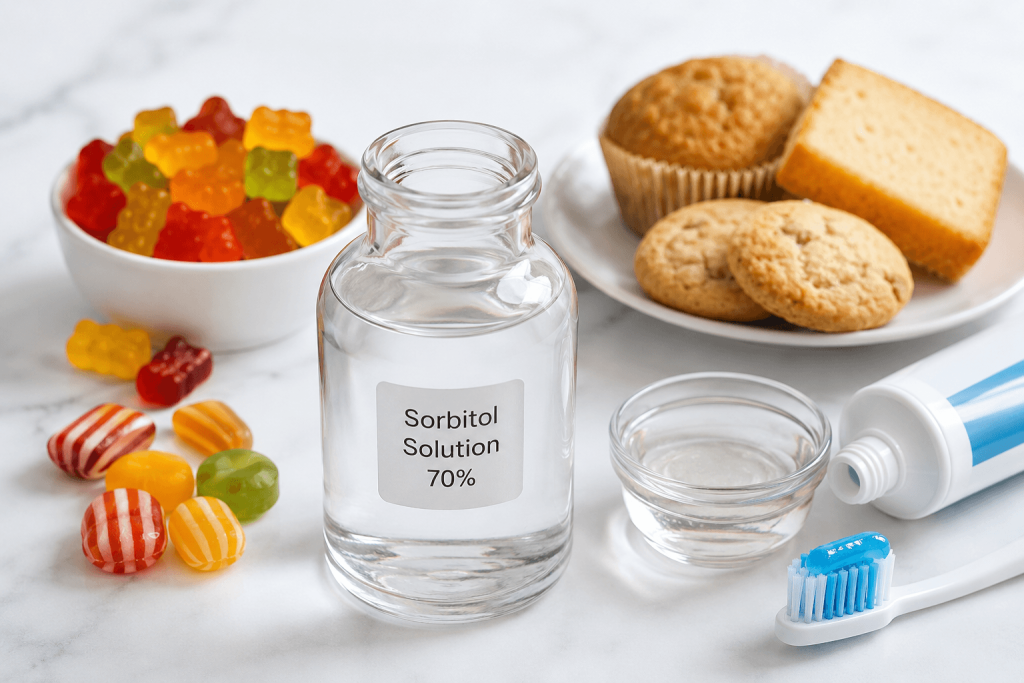
Applications: Food & Beverage(Sugar-free confectionery, Chewing gum, Bakery & fillings), Pharmaceutical(Oral syrups, Excipients), Personal Care(Toothpaste, Mouthwash)
Appearance/color: Colourless sticky liquid
Package: 275 kg drum, 22ton per 20FCL
Why Formulators Choose Sorbitol Syrup 70%
Sorbitol Syrup 70% serves multiple functions in a formulation:
Humectant for moisture retention
Bulk sweetener and sugar replacer
Anti-crystallization agent
Texture modifier
Water activity (Aw) reducer
Plasticizer in gel systems
Shelf-life enhancer
These functionalities make it suitable for a wide range of products, including gummies, confectionery, baked goods, syrups, beverages, oral care products, and pharmaceutical preparations.
Application 1: Gummies and Nutraceutical Chews
Gummies are one of the fastest-growing applications for Sorbitol Syrup 70%.
Key Benefits
Helps maintain soft and chewy texture
Reduces moisture loss during storage
Minimizes sugar crystallization and graining
Supports lower water activity for improved shelf life
Improves flexibility and bite consistency
What R&D Teams Should Monitor
When developing gummy formulations, formulators typically focus on:
Dry Solids (DS)
Sorbitol content
Viscosity
Water activity control
Reducing sugar levels
Non-crystallizing performance
High-quality non-crystallizing grades are often preferred for vitamin gummies, botanical gummies, and sugar-free gummy applications.
Application 2: Sugar-Free Confectionery
Sorbitol Syrup 70% is widely used in hard candies, soft candies, and sugar-free confectionery products.
Key Benefits
Provides bulk similar to sugar
Delivers clean sweetness
Reduces crystallization issues
Supports sugar reduction claims
Improves product stability during storage
Formulators often combine sorbitol with isomalt, maltitol syrup, erythritol, or high-intensity sweeteners to achieve desired sweetness and texture profiles.
Application 3: Bakery Products
In baked goods, moisture management is essential for maintaining freshness.
Key Benefits
Retains moisture during storage
Delays staling
Improves softness
Extends shelf life
Enhances mouthfeel
Applications include:
Cakes
Muffins
Cookies
Protein bakery products
Reduced-sugar baked goods
Application 4: Beverage Formulations
Sorbitol Syrup 70% can be used in selected beverage systems where sweetness and mouthfeel enhancement are required.
Key Benefits
Improves body and mouthfeel
Supports sweetness adjustment
Provides smooth flavor delivery
Helps stabilize certain formulations
Typical applications include:
Functional beverages
Nutritional drinks
Syrups
Concentrates
Application 5: Pharmaceutical Syrups
Sorbitol has long been used in pharmaceutical formulations due to its stability and functionality.
Key Benefits
Pleasant sweetness profile
Humectant functionality
Excellent solubility
Good compatibility with active ingredients
Common applications include:
Oral syrups
Cough formulations
Pediatric products
Nutritional supplements
Application 6: Oral Care Products
Sorbitol Syrup 70% is a standard ingredient in oral care formulations.
Key Benefits
Prevents product drying
Maintains smooth texture
Improves mouthfeel
Supports flavor stability
Typical applications include:
Toothpaste
Mouthwash
Oral gels
Key Technical Parameters R&D Teams Evaluate
When selecting a supplier, formulation scientists usually review several critical quality indicators.
1. Dry Substance (DS)
Typical Specification: 70 ± 2%
Why it matters:
Influences processing performance
Affects final product moisture
Impacts shelf life and texture
2. Sorbitol Assay
Typical Specification: ≥50%
Why it matters:
Ensures batch consistency
Supports predictable sweetness
Maintains humectant performance
3. Reducing Sugars
Typical Specification: ≤0.2%
Why it matters:
Reduces Maillard browning
Improves color stability
Protects sensitive vitamins and amino acids
This parameter is particularly important in nutraceutical gummies and functional foods.
4. Non-Crystallizing Performance
Why it matters:
Prevents graining
Maintains product transparency
Supports long-term storage stability
This is often a key requirement for gummy manufacturers.
5. Viscosity
Why it matters:
Affects pumping and transfer
Influences mixing efficiency
Impacts manufacturing consistency
Many R&D teams request viscosity data at multiple temperatures such as 20°C, 40°C, and 60°C.
6. pH
Typical Range: 5.0–7.5
Why it matters:
Ingredient compatibility
Color stability
Preservative system performance
7. Water Activity Control
Why it matters:
Extends shelf life
Improves microbial stability
Supports texture retention
Water activity management is one of the primary reasons formulators use sorbitol in gummies and confectionery products.
Typical Supplier Qualification Checklist
Before commercial approval, many techinical scientists evaluate:
Appearance
Sorbitol content
Dry solids
Reducing sugars
pH
Heavy metals
Microbiological limits
Non-crystallizing performance
Regulatory compliance
Batch-to-batch consistency
Reliable technical documentation and application support are also important considerations during supplier selection.
Conclusion
Sorbitol Syrup 70% is far more than a sweetener. It functions as a humectant, anti-crystallization agent, texture modifier, and shelf-life enhancer across numerous applications. For formulators working on gummies, sugar-free confectionery, bakery products, beverages, pharmaceuticals, or oral care products, understanding key parameters such as dry solids, reducing sugars, viscosity, pH, and non-crystallizing performance is essential for successful product development.
By selecting a high-quality Sorbitol Syrup 70% supplier and evaluating the right technical specifications, product developers can achieve better processing efficiency, improved stability, and superior consumer experience.