
In the growing global market for cognitive health and nootropic nutrition, three ingredients consistently stand out: Phosphatidylserine (PS), Docosahexaenoic acid (DHA), and Ginkgo biloba.
These three ingredients are frequently used in brain health supplements, functional beverages, gummies, and medical nutrition products. However, they are often misunderstood as interchangeable “memory boosters,” when in fact they work through very different biological mechanisms.
This article provides a comprehensive comparison of Phosphatidylserine, DHA, and Ginkgo from a scientific, functional, and product development perspective, helping brands, formulators, and consumers choose the right ingredient for the right application.
Brain health is now one of the fastest-growing categories in functional nutrition.
1. Why Brain Health Ingredients Are Growing Fast
Key market drivers include:
Aging global population and cognitive decline concerns
High stress levels in modern lifestyles
Demand from students and professionals for focus enhancement
Growth of functional foods (gummies, drinks, bars)
Shift toward preventive mental wellness
Increasing interest in “nootropic” ingredients
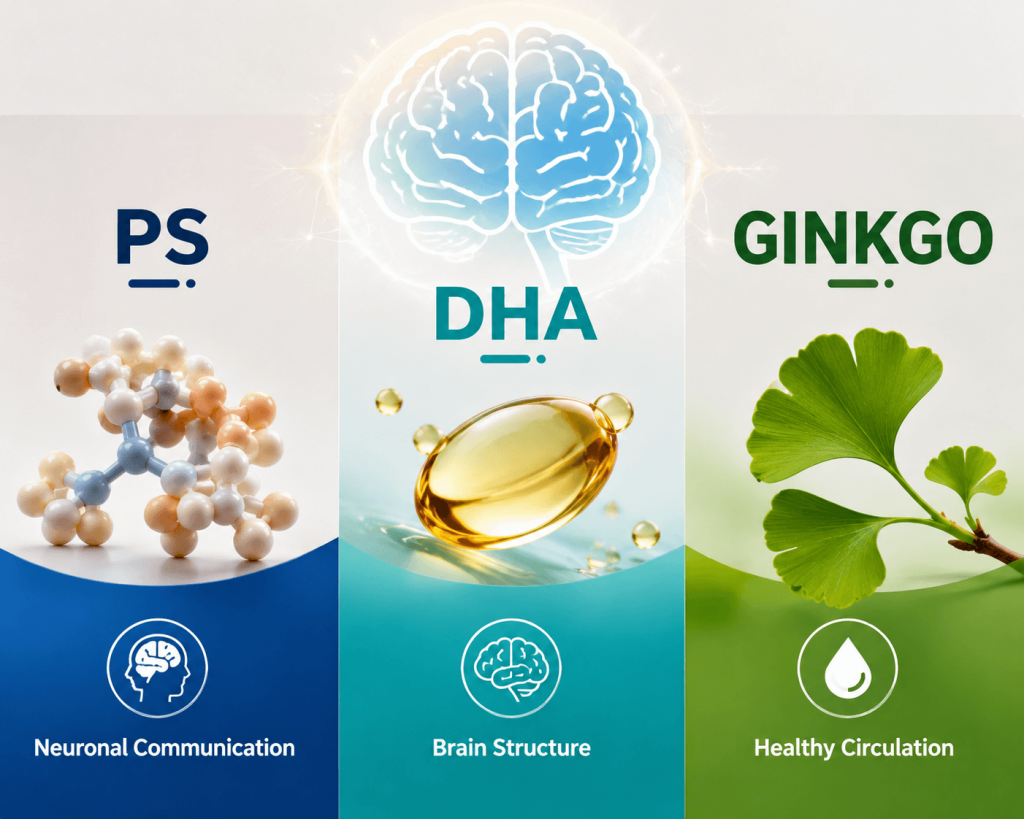
Within this landscape, Phosphatidylserine, DHA, and Ginkgo represent three distinct functional strategies:
Phosphatidylserine → neuron membrane & cognition
DHA → brain structure & development
Ginkgo → circulation & oxygen delivery
Understanding these differences is critical for successful product formulation.
2. Overview of the Three Ingredients
2.1 Phosphatidylserine (PS)
PS is a naturally occurring phospholipid found in high concentrations in brain cell membranes. It plays a key role in:
Cell membrane integrity
Signal transmission between neurons
Neurotransmitter activity
Stress response regulation
Phosphatidylserine (PS) is widely used in cognitive health supplements targeting memory, attention, and mental performance.
2.2 DHA (Docosahexaenoic Acid)
DHA is an omega-3 fatty acid that is a structural component of the brain and retina. It is essential for:
Brain development (especially in infants and children)
Neuron membrane fluidity
Visual function
Long-term cognitive maintenance
DHA is most commonly derived from fish oil or algae oil.
2.3 Ginkgo Biloba Extract
Ginkgo is a botanical extract rich in flavonoids and terpene lactones. It is primarily known for:
Improving cerebral blood circulation
Enhancing oxygen and glucose delivery to the brain
Antioxidant activity
Supporting mental clarity in aging populations
It is one of the most widely used herbal ingredients in cognitive supplements worldwide.
3. Mechanism of Action: How They Work in the Brain
3.1 Phosphatidylserine (PS): Neurotransmission & Cell Membrane Function
PS works directly at the cellular level in the brain:
Supports phospholipid membrane structure
Enhances neuron-to-neuron communication
Influences acetylcholine, dopamine, and serotonin pathways
Helps regulate cortisol (stress hormone)
Functional result: better memory encoding, focus stability, and stress resilience
3.2 DHA: Structural Brain Nutrient
DHA is a foundational building block:
Maintains flexibility of neuron membranes
Supports synaptic plasticity
Plays a critical role in brain development
Reduces neuroinflammation over time
Functional result: long-term brain development and cognitive maintenance
3.3 Ginkgo: Cerebral Circulation Enhancer
Ginkgo acts primarily through vascular mechanisms:
Improves blood flow in microcapillaries
Enhances oxygen delivery to brain tissues
Reduces oxidative stress
Supports mitochondrial energy metabolism
Functional result: mental clarity, alertness, and reduced cognitive fatigue
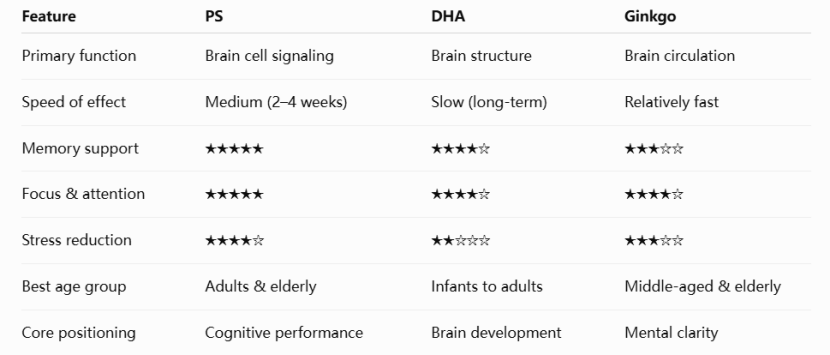
4. Functional Comparison Table
5. Target Population Differences
5.1 Phosphatidylserine (PS): Cognitive Performance & Stress Management
PS is widely used for:
Students during exams
Office workers under mental pressure
Aging adults with memory decline
Individuals with high cognitive workload
It is particularly strong in attention, recall, and stress adaptation.
5.2 DHA: Brain Development & Long-Term Health
DHA is essential for:
Pregnant women (fetal brain development)
Infants and children
Long-term preventive brain health
Eye and vision development
It is more of a foundational nutrient than a short-term performance booster.
5.3 Ginkgo: Circulation and Aging Brain Support
Ginkgo is commonly used by:
Elderly populations
Individuals with reduced mental clarity
People experiencing brain fog or fatigue
Users seeking mild cognitive enhancement
It is more related to blood flow and oxygen delivery than neuron structure.
6. Application in Functional Foods and Supplements
6.1 Capsules & Tablets (Traditional Form)
All three ingredients are widely used in:
Cognitive health capsules
Multivitamin brain formulas
Anti-aging supplements
Typical positioning:
PS → premium nootropic
DHA → essential nutrient blend
Ginkgo → herbal cognition support
6.2 Gummies (Fast-Growing Segment)
Functional gummies are becoming a key delivery system:
Memory support gummies (PS + vitamins)
Kids brain development gummies (DHA)
Focus & energy gummies (Ginkgo blends)
Advantages:
High consumer compliance
Pleasant taste masking
Strong marketing appeal
6.3 Functional Beverages
Emerging applications include:
Brain focus drinks
Energy + cognition beverages
Stress relief functional drinks
Typical combinations:
PS + L-theanine
DHA emulsions
Ginkgo extract + caffeine blends
7. Synergy: Why They Are Often Combined
Rather than competing, PS, DHA, and Ginkgo are often used together in advanced formulations.
Synergistic model:
DHA builds the structure (foundation)
PS improves communication (function)
Ginkgo improves circulation (delivery)
Together they support:
Memory formation
Mental energy
Focus endurance
Age-related cognitive decline management
This multi-layer approach is increasingly preferred in premium brain health products.
8. Formulation Considerations for R&D Teams
8.1 Stability
Phosphatidylserine (PS): Sensitive to oxidation, requires encapsulation
DHA: Highly oxidation-prone, needs antioxidant protection
Ginkgo: More stable but sensitive to light in liquid systems
8.2 Taste Masking
DHA: Strong fishy taste (major formulation challenge)
Phosphatidylserine (PS): Neutral but slightly bitter in some forms
Ginkgo: Herbal bitterness, needs flavor balancing
8.3 Compatibility in Gummies
DHA: Requires emulsification technology
Phosphatidylserine (PS): Suitable for powder blending
Ginkgo: Highly compatible with fruit flavors
9. Market Trends in Cognitive Nutrition
The global cognitive health market is shifting toward:
Clean label formulations
Plant-based and algae-based DHA
Natural nootropics (Ginkgo, L-theanine, Bacopa)
Combination formulas (multi-mechanism blends)
Functional gummies replacing capsules
Phosphatidylserine (PS) is gaining strong traction in:
“Focus + stress” positioning
Adult cognitive performance supplements
Premium nootropic brands
DHA remains dominant in:
Infant nutrition
Prenatal health
Omega-3 supplementation
Ginkgo continues strong in:
Herbal memory supplements
Asian and European markets
Aging population products
10. Conclusion: Which One Should Be Used?
There is no “best” ingredient—only the right mechanism for the right goal.
Choose PS when targeting: memory, focus, stress resilience
Choose DHA when targeting: brain development and long-term structure
Choose Ginkgo when targeting: circulation, alertness, and mental clarity
From a formulation perspective, the most advanced products today are not single-ingredient solutions, but multi-pathway cognitive systems combining structure + function + circulation support.