
The global brain health market is undergoing a massive paradigm shift. Not long ago, cognitive enhancement supplements were strictly confined to the pharmacy aisle—pills, tablets, and hard capsules taken by seniors or patients with specific therapeutic needs.
Today, the narrative has completely changed. Driven by stressed-out Gen Z professionals, burnt-out Millennials, and active aging Boomers, the demand for cognitive support has moved from reactive treatment to proactive, daily wellness. Consumers want focus, memory support, and stress relief, but they want it integrated into their lifestyle. They want food, beverages, and, above all, gummies.
For food and beverage brands, this shift represents a massive commercial opportunity. At the center of this cognitive revolution is Phosphatidylserine (PS), a scientifically backed, gold-standard ingredient for brain health.
However, moving a highly functional ingredient like Phosphatidylserine from a dry capsule into an indulgent, shelf-stable gummy or functional beverage is not without its challenges. In this comprehensive guide, we explore how R&D teams and product innovators can successfully formulate with PS to capture the booming delivery format market.
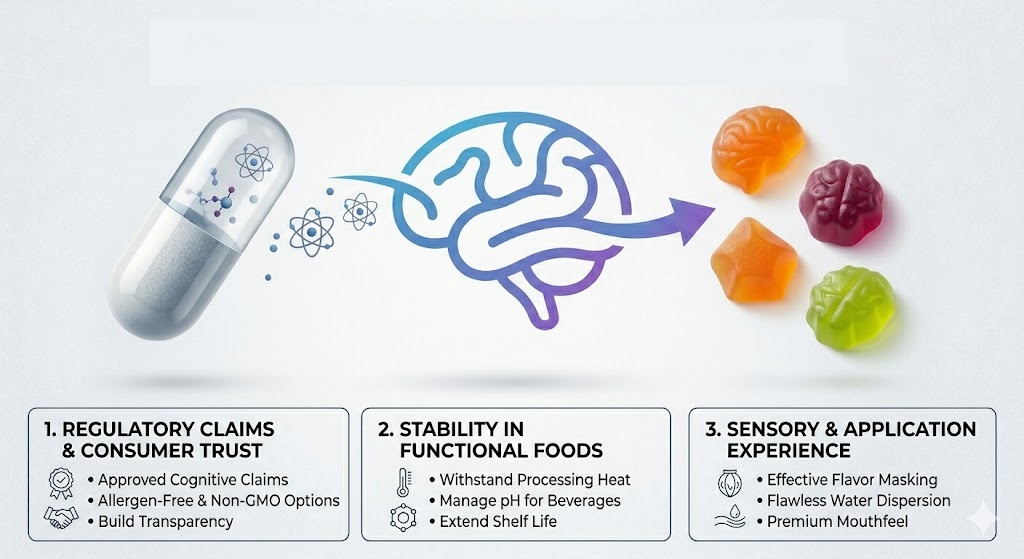
Why Phosphatidylserine (PS) is Leading the Brain Health Boom
When innovating in the cognitive space, ingredient credibility is non-negotiable. Modern consumers read labels, research active ingredients on TikTok and PubMed, and demand proven efficacy. This is where Phosphatidylserine shines.
PS is a naturally occurring phospholipid found in high concentrations within the cellular membranes of the brain. It plays a critical role in maintaining fluid cell membranes, facilitating neurotransmitter release, and supporting overall cognitive function.
Unlike many botanical ingredients that rely purely on traditional folklore, PS boasts robust clinical backing:
Approved Health Claims: In many jurisdictions, including the US FDA (Qualified Health Claims) and European markets, PS is recognized for its ability to support memory, focus, and cognitive decline risk reduction.
Broad Demographic Appeal: It addresses age-related cognitive decline in older adults, while simultaneously appealing to younger demographics seeking “nootropics” for productivity and stress management.
But as consumers experience “pill fatigue,” traditional capsules are losing market share to delivery formats that offer a superior sensory experience.
The Delivery Format Revolution: The Rise of Functional Gummies
According to recent market research, gummies and soft chews are the fastest-growing delivery formats in the nutraceutical space. Once reserved for children’s multivitamins, functional gummies have captured the adult market due to three core factors:
1. Convenience: No water required; they can be consumed on the go.
2. Sensory Gratification: They turn a health routine into a rewarding, candy-like treat.
3. Immersive Wellness: Consumers prefer eating a functional snack over swallowing a medicinal pill.
For product managers, transitioning your PS formulation to a gummy matrix can dramatically lower the barrier to consumer trial and boost repeat purchase rates. But from a formulation standpoint, gummies are dynamic, moisture-heavy chemical environments that require precision engineering.
Technical Challenges in PS Formulation (And How to Solve Them)
If you hand standard Phosphatidylserine powder to a food scientist and ask them to make a stable, delicious gummy, they will likely run into several technical roadblocks. Raw PS is inherently lipophilic (fat-soluble), sensitive to heat, and possesses distinct organoleptic properties.
Here is how advanced ingredient engineering solves the four major challenges of formulating with PS:
1. Solubility and Dispersion: Preventing Phase Separation
Traditional PS is a lipid, meaning it does not naturally dissolve in water. In a liquid beverage or a water-based gelatin/pectin gummy slurry, standard PS will separate, forming oily droplets or settling at the bottom. This leads to inconsistent dosing and poor aesthetics.
The Solution: Innovators must utilize microencapsulated or water-dispersible PS powders. Through advanced emulsification and spray-drying technologies, lipophilic PS can be transformed into free-flowing, hydrophilic particles that disperse flawlessly throughout gummy matrices or functional beverages without separation.
2. Thermal Stability: Surviving the Cook Cycle
Gummy manufacturing requires heat. The candy mass (whether gelatin, pectin, or starch-based) is typically cooked at temperatures ranging from 90°C to over 110°C before being deposited into molds. Because PS contains delicate fatty acid chains, excessive heat and prolonged exposure to oxygen can cause thermal degradation, reducing the active potency of your final product.
The Solution: Work with stable PS grades specifically optimized for food processing. Furthermore, R&D teams should adopt a late-stage addition strategy, introducing the microencapsulated PS at the cooling phase just before depositing into the molds to minimize thermal stress.
3. Sensory Profile: Masking the “Phospholipid” Taste
Soy- or sunflower-derived PS can carry a distinct earthy, soapy, or beany off-note. In a capsule, this taste is hidden. In a chewable gummy or a RTD (Ready-to-Drink) tea, an unmasked off-note will instantly kill repeat sales.
The Solution: Advanced flavor masking is essential. Coupling PS with tart, robust fruit flavor profiles (such as citrus, dark berry, or green apple) naturally complements and masks the lipid undertones. Additionally, premium microencapsulation acts as a physical barrier, preventing the active ingredient from interacting with taste buds until it is swallowed.
4. Shelf-Life and Oxidation Management
Because PS contains unsaturated fatty acids, it is inherently vulnerable to lipid oxidation when exposed to light, air, and moisture. Oxidation results in a rancid flavor profile and a drop in active ingredient assay over time, compromising your label claims.
The Solution: Formulators should incorporate natural synergetic antioxidants, such as mixed tocopherols (Vitamin E) or rosemary extract, directly into the gummy formulation. Pair this with high-barrier, opaque packaging to shield the finished product from UV light and oxygen transmission.
Choosing the Right Source: The Clean Label Advantage
Beyond physical form, the source of your Phosphatidylserine matters tremendously for market positioning. Historically, PS was derived from bovine cortex, which was abandoned due to safety concerns (BSE). For years, Soy-derived PS became the industry standard.
However, in today’s market, soy presents two significant hurdles: allergens and GMO concerns.
To capture the premium, “Clean Label” consumer, market leaders are increasingly pivoting to Sunflower-derived Phosphatidylserine. Sunflower PS offers several distinct commercial advantages:
100% Allergen-Free: Eliminates the need for mandatory allergen warnings on your packaging.
Non-GMO by Nature: Naturally meets the clean-label criteria preferred by premium natural food retailers.
Identity Preserved (IP): Provides a transparent, traceable supply chain that builds brand trust.
Partnering for Innovation: Accelerate Your Time-to-Market
Innovating in the functional brain health space requires more than just buying a raw ingredient off the shelf; it requires a deep understanding of food chemistry, matrix interactions, and regulatory compliance.
At Qingdao Nihao we don’t just supply premium-grade, sunflower-derived Phosphatidylserine—we supply solutions. Our dedicated application scientists work side-by-side with your R&D teams to provide customized, highly stable, water-dispersible PS formulations tailored specifically for gummies, functional beverages, and powders.
Ready to take your brain health portfolio to the next level and capture the functional food market? [Contact our application experts today] to request a sample of our optimized PS solutions or to schedule a technical consultation. Let’s build the next generation of cognitive wellness together.