
Gardenia Blue: A Natural Blue Colorant Gaining Attention in the Beauty Industry
As consumer demand for natural, plant-based, and sustainable cosmetic ingredients continues to grow, manufacturers are actively searching for alternatives to synthetic colorants. Among the emerging natural pigments, Gardenia Blue has attracted increasing interest due to its vibrant blue hue, excellent stability, and botanical origin.
Gardenia Blue, also known as Genipin Blue, is produced through a reaction between genipin, a natural compound extracted from Gardenia fruits (Gardenia jasminoides), and amino acids. This reaction forms a stable blue pigment that has been widely used in food applications and is now drawing attention from cosmetic formulators worldwide.
Compared with many natural blue pigments that suffer from poor stability, Gardenia Blue offers several technical advantages, including good heat resistance, light stability, and relatively broad pH tolerance. These characteristics make it a promising candidate for a variety of cosmetic and personal care applications.
Why Cosmetic Brands Are Interested in Gardenia Blue
The global beauty industry is experiencing a strong shift toward “Clean Beauty,” where consumers prefer recognizable, naturally sourced ingredients over synthetic additives.
Gardenia Blue aligns well with this trend because it offers:
Natural plant-derived origin
Deep and attractive blue coloration
Good heat and light stability
Favorable performance across a wide pH range
Compatibility with clean-label and sustainable product concepts
These advantages have encouraged cosmetic manufacturers to explore Gardenia Blue in both decorative cosmetics and skincare formulations.
Major Applications of Gardenia Blue in Cosmetics
1. Color Cosmetics and Makeup Products
One of the most direct applications of Gardenia Blue is as a natural blue colorant in makeup products.
It can be used in:
Eyeshadows
Eyeliners
Lipsticks
Lip glosses
Nail polishes
Color-correcting cosmetic products
Its deep blue shade allows formulators to create various blue, indigo, and violet tones while supporting natural or botanical product positioning. Unlike some synthetic dyes, Gardenia Blue can help brands market products with a more natural ingredient profile.
Furthermore, its relatively good light stability helps maintain color consistency throughout the product’s shelf life.
2. Visual Enhancement in Skincare Products
Color plays an important role in consumer perception.
Many skincare brands use blue-colored formulations to communicate benefits such as:
Hydration
Soothing effects
Skin calming
Refreshing sensations
Post-sun recovery
Gardenia Blue can be incorporated into serums, creams, gels, masks, and facial treatments to strengthen these visual cues.
The cool blue appearance often creates an immediate impression of freshness and comfort, supporting brand storytelling and product differentiation.
3. Hair Care and Personal Care Products
Gardenia Blue is increasingly being explored in:
Shampoos
Conditioners
Body washes
Shower gels
Hand soaps
Bath products
In these applications, the pigment provides an appealing visual appearance while reinforcing a natural, plant-based product image.
As consumers become more conscious about ingredient transparency, botanical colorants like Gardenia Blue may offer an attractive alternative to synthetic dyes traditionally used in personal care formulations.
4. Functional Skincare Potential
Beyond coloration, researchers have shown interest in genipin-derived compounds due to their biological activities.
Studies suggest that genipin and related derivatives may possess:
Antioxidant properties
Anti-inflammatory potential
Protective effects against oxidative stress
Although Gardenia Blue is primarily used as a colorant, some formulators view it as an ingredient that could contribute additional value in advanced skincare systems.
Further research is still needed to fully understand its cosmetic efficacy, but its multifunctional potential remains an area of growing scientific interest.
Global Regulatory Status of Gardenia Blue in Cosmetics
Despite its increasing popularity, the regulatory status of Gardenia Blue varies significantly across different countries and regions.
A key challenge is that approval for food use does not automatically permit cosmetic use. Regulatory agencies generally evaluate color additives separately for food, pharmaceutical, and cosmetic applications.
Below is an overview of the current regulatory landscape.
United States
Food Applications
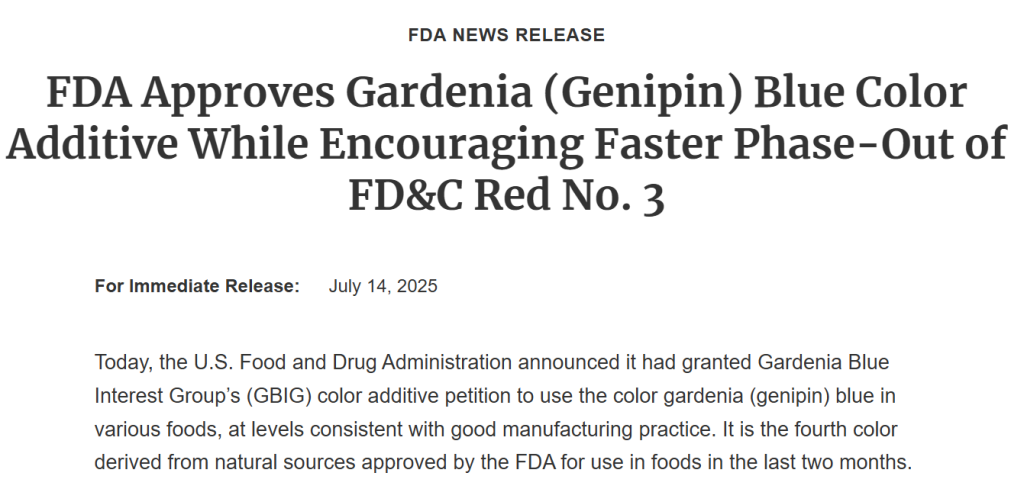
A major regulatory milestone was achieved in 2025 when the U.S. Food and Drug Administration (FDA) approved Gardenia Blue as a food color additive.
Effective August 29, 2025, Gardenia Blue was included under 21 CFR 73.168 as a color additive exempt from batch certification.
This approval significantly increased industry confidence in the safety profile of Gardenia Blue for food applications.
Cosmetic Applications
However, cosmetic approval remains a different matter.
Under FDA regulations, color additives must receive separate authorization for specific uses. A color additive approved for food use is not automatically approved for cosmetic products.
Currently, Gardenia Blue does not appear to be specifically listed as an approved cosmetic color additive under the FDA cosmetic color additive regulations contained in 21 CFR Parts 73 or 74.
As a result, companies intending to use Gardenia Blue as a cosmetic colorant in the United States should carefully evaluate regulatory requirements and consult relevant compliance specialists before commercialization.
South Korea
South Korea is one of the world’s most innovative beauty markets and has shown strong interest in naturally derived cosmetic ingredients.
The country’s regulatory authority, the Ministry of Food and Drug Safety (MFDS), often considers international safety evaluations, including assessments conducted by international expert committees.
Gardenia Blue has a long history of food use in Korea. However, its adoption as a dedicated cosmetic colorant remains relatively limited.
Under Korean cosmetic regulations, colorants are managed through specific standards governing cosmetic pigments and testing methods.
In practice, Gardenia-derived ingredients are more commonly found in cosmetic ingredient lists under broader descriptions such as Gardenia extract rather than being marketed specifically as Gardenia Blue colorants.
As consumer demand for natural cosmetics continues to increase, the market may present future opportunities for naturally sourced blue pigments.
China
Food Applications
In China, Gardenia Blue is an officially approved food additive under the national food additive standard GB 2760 and has been used in various food categories for many years.
Cosmetic Applications
The cosmetic regulatory situation is more complex.
According to the Inventory of Existing Cosmetic Ingredients in China (IECIC 2021), Gardenia-derived ingredients and Gardenia fruit extracts may be used as cosmetic ingredients when serving functions such as skin conditioning or botanical extract applications.
However, when Gardenia Blue is used specifically as a color additive, manufacturers must comply with the permitted colorant requirements outlined in the Safety and Technical Standards for Cosmetics.
At present, Genipin Blue or Gardenia Blue is not explicitly listed as an approved standalone cosmetic colorant within China’s permitted color additive catalogue.
Therefore, cosmetic companies should carefully assess product positioning, ingredient function claims, and regulatory compliance before launching products containing Gardenia Blue in the Chinese market.
Future Outlook
The beauty industry’s transition toward natural and sustainable ingredients continues to accelerate. As brands seek alternatives to synthetic dyes, Gardenia Blue stands out as one of the most promising natural blue pigments currently available.
Its combination of:
Natural origin
Excellent color performance
Heat and light stability
Compatibility with Clean Beauty trends
Potential antioxidant and skin-supporting properties
makes it increasingly attractive for cosmetic innovation.
However, regulatory frameworks for cosmetic colorants remain more restrictive than those for food applications. Manufacturers interested in utilizing Gardenia Blue should closely monitor regulatory developments in key markets, particularly the United States, South Korea, and China.
As scientific research and regulatory acceptance continue to evolve, Gardenia Blue is expected to play an increasingly important role in the future of natural cosmetic formulation.