
1. Introduction: Why Allulose Sweetener Is Gaining Attention Globally
Allulose (D-psicose) is a rare sugar naturally found in small quantities in fruits such as figs and raisins. In recent years, it has emerged as one of the most promising low-calorie sweeteners for sugar reduction strategies in food and beverage innovation.
With increasing demand for clean label, low sugar, and functional nutrition products, allulose is now widely evaluated by both consumers and food R&D teams.
However, the key decision drivers are very different depending on perspective:
Consumers focus on health perception and taste experience
R&D teams focus on functionality, stability, and formulation performance
Understanding both perspectives is essential for successful product development.
2. What Consumers Care About When Choosing Allulose Sweetener
2.1 Low Calories and Blood Sugar Impact
The primary attraction of allulose is its metabolic behavior:
Extremely low caloric value (~0.2–0.4 kcal/g)
Minimal impact on blood glucose and insulin response
Often used in “sugar-free” or “reduced sugar” products
For consumers, the core question is simple:
“Can I enjoy sweetness without affecting my weight or blood sugar?”
2.2 Digestive Tolerance and Daily Comfort
Compared with sugar alcohols like erythritol or maltitol, allulose is generally considered more digestive-friendly. However, consumers still ask:
Will it cause bloating or laxative effects?
Is it suitable for daily consumption?
How much is safe per day?
This makes gastrointestinal tolerance a critical marketing point.
2.3 Taste Profile and Sensory Experience
Taste is one of the strongest drivers of repeat purchase:
Sweetness level is approximately 70% of sucrose
Clean sweetness with minimal aftertaste
No strong cooling effect like some polyols
Consumers expect a “sugar-like experience without sugar consequences.”
2.4 Clean Label and Natural Positioning
Modern consumers prefer ingredients that sound natural:
“Rare sugar” positioning is more attractive than synthetic sweeteners
Derived from natural sources via enzymatic conversion
Compatible with clean label trends
Perception is often as important as functionality in purchasing decisions.
3. What Food R&D Teams Care About in Allulose Applications
3.1 Thermal Stability and Processing Performance
One of the most important technical questions is:
Can allulose survive industrial processing?
R&D teams evaluate:
Stability under high-temperature processing (baking, UHT)
Behavior in acidic systems (pH 3–4 beverages)
Compatibility with proteins, acids, and hydrocolloids
Unlike some sweeteners, allulose is relatively stable but can behave differently under heat compared to sucrose.
3.2 Maillard Reaction and Browning Performance
A unique functional advantage of allulose is its participation in the Maillard reaction.
In bakery applications:
Promotes desirable browning
Enhances flavor development
Improves visual appeal of baked goods
However, formulators must control:
Over-browning risks
Color consistency during shelf life
This makes it both a functional advantage and a formulation challenge.
3.3 Sweetness Replacement Strategy
Allulose is not a 1:1 sugar replacement in all systems.
R&D teams typically consider:
Relative sweetness (~70% of sucrose)
Combination with high-intensity sweeteners (e.g., stevia, monk fruit)
Bulking system adjustments for texture and volume
Successful formulation often requires a sweetener blend strategy rather than single-ingredient substitution.
3.4 Texture, Solubility, and Mouthfeel
In different applications, physical performance matters:
Rapid solubility in beverages
Minimal crystallization risk
Impact on viscosity in syrups and gels
In gummies and confectionery:
Influences chewiness and elasticity
Affects moisture retention and shelf stability
3.5 Cost and Industrial Scalability
Despite its functional benefits, cost remains a key barrier:
Higher price compared to erythritol and sucrose
Supply chain consistency is critical for large-scale production
Cost-in-use optimization is necessary in commercial formulations
R&D teams often balance:
performance vs. cost efficiency
3.6 Regulatory and Labeling Considerations
Regulatory status influences global adoption:
Generally recognized as safe (GRAS) in the United States
Increasing approvals in multiple regions
Labeling claims such as “sugar-free” or “reduced sugar” depend on local regulations
Correct positioning is essential for global product launches.
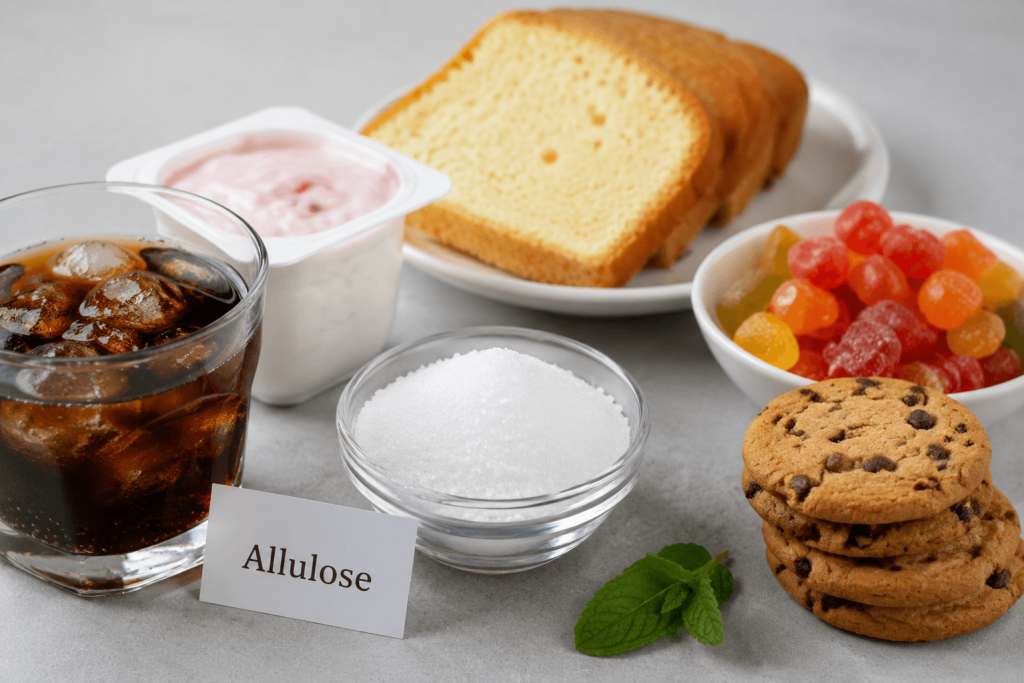
4. Key Application Areas of Allulose
Allulose is widely used across multiple categories:
Beverages
Low-sugar soft drinks
Functional drinks
Dairy-based beverages
Bakery
Cakes, cookies, muffins
Improved browning and flavor development
Confectionery
Gummies and candies
Sugar-reduced chocolate systems
Dairy and Frozen Desserts
Yogurts and ice creams
Smooth mouthfeel with reduced sugar load
5. Conclusion: The Dual Value of Allulose
Allulose is more than just a sweetener—it is a functional sugar replacement platform.
From a consumer perspective, it delivers:
Lower calories
Stable blood sugar response
Sugar-like taste experience
From an R&D perspective, it offers:
Thermal and process adaptability
Maillard reaction functionality
Flexible formulation integration
However, successful product development requires balancing:
taste, stability, cost, and regulatory positioning
Final Insight
The real value of allulose lies in bridging two expectations:
consumers want “real sugar experience without health burden,” while R&D teams want “sugar functionality without formulation compromise.”