
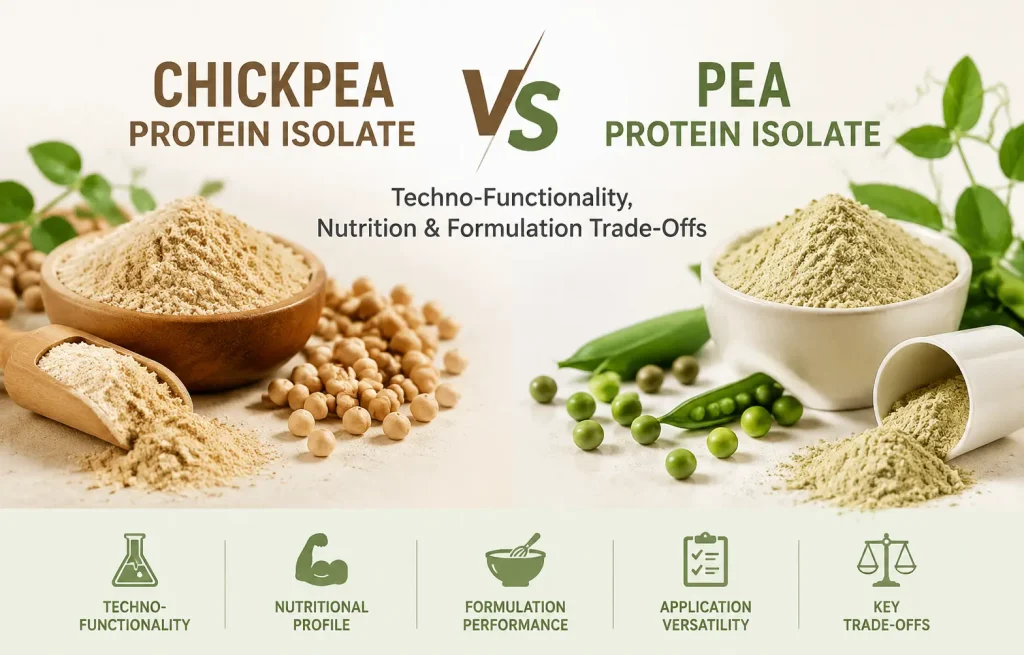
Chickpea Protein Isolate vs Pea Protein Isolate: Techno‑Functionality, Nutrition & Formulation Trade‑Offs
2026 has marked a pivotal turning point for global plant‑based protein formulation. Driven by skyrocketing whey protein prices, stricter clean‑label regulations, and new pulse crop innovation, food formulators are actively diversifying away from traditional pea and soy protein sources. As one of the fastest‑growing plant protein categories, chickpea protein isolate has gained massive industry traction, supported by 2026 breakthroughs including NuCicer’s new high‑protein Nuchi chickpea variety and advanced enzyme‑membrane extraction technologies.
Pea protein isolate has long dominated pulse‑based formulations due to its mature supply chain and strong gelling properties. However, peer‑reviewed food science studies and 2026 industrial trial data confirm clear technical and sensory gaps between chickpea protein isolate (ChPI) and pea protein isolate (PPI). This article provides a scientific, application‑oriented comparison to help R&D teams select the optimal protein for clean‑label beverages, dairy alternatives, bakery, and nutritional foods.
2026 Market & R&D Background for Pulse Proteins
The global chickpea protein market is projected to reach USD 226.9 million in 2026, growing at a 10.8% CAGR through 2036, making it one of the fastest‑expanding plant protein segments. Two key industry shifts are reshaping ingredient selection this year:
- New‑generation chickpea raw material upgrade NuCicer’s 2026 launched Nuchi™ high‑protein chickpea variety delivers 50% higher protein content and 25% lower fat than conventional chickpeas. This non‑GMO breeding innovation eliminates redundant defatting processes, reduces production costs, and further improves the mild, clean sensory profile of commercial chickpea protein isolates.
- Advanced industrial extraction optimization Traditional alkali‑acid precipitation is gradually replaced by enzyme‑assisted and membrane separation technologies. Modern purified chickpea protein isolate production effectively reduces anti‑nutrient residuals, improves solubility stability, and minimizes off‑flavor formation — solving historic technical bottlenecks of conventional chickpea protein.
- Whey protein supply crisis accelerates plant protein substitution Persistent global whey price surges and tight supply chains in 2026 have pushed food manufacturers to adopt cost‑stable, soy‑free pulse protein alternatives. Chickpea protein, with its low‑prevalence allergen profile and neutral‑taste advantages, has become a premium replacement for both whey and overused pea protein.
Chickpea Protein Isolate vs Pea Protein Isolate: Core Functional Comparison
When selecting between chickpea protein isolate vs pea protein isolate, R&D teams need to evaluate not only nutritional indexes but also real‑world processing performance for target end‑products.
The table below summarizes journal‑verified functional and sensory differences for commercial‑grade 80–85% isolates:
| Evaluation Item | Chickpea Protein Isolate | Pea Protein Isolate |
|---|---|---|
| Sensory Profile | Mild nutty flavor, negligible beany aftertaste | Strong grassy, earthy off‑flavor |
| pH Solubility Stability | Excellent in neutral & weak acid systems | Poor solubility below pH 6.0, easy sedimentation |
| Thermal Gel Property | Soft, elastic, tender texture | High rigidity, strong thermal gel strength |
| Emulsification & Water Holding | Stable, balanced performance for beverages & dairy alternatives | High emulsifying activity, suitable for textured products |
| Allergen Risk | Low epidemiological allergy incidence | Rising pea allergy cases in EU & North America |
| Best Application Scenarios | Plant milk, yogurt, RTD drinks, soft bakery, sensitive‑diet foods | Meat analogues, hard extruded snacks, high‑texture formulas |
Nutritional Profile & Digestibility Science
Both chickpea and pea protein isolates deliver complete essential amino acid profiles and meet FAO/WHO protein requirements for human nutrition.
Recent 2026 clinical and food chemistry studies confirm that modern purified chickpea protein features lower residual anti‑nutritional factors and a more balanced lysine‑arginine ratio. Its amino acid digestibility is statistically comparable or superior to conventional pea protein, especially for mild‑processing beverage and nutritional powder formulations.
While pea protein contains slightly higher crude protein in general batches, its higher residual legume metabolites lead to more noticeable gastrointestinal discomfort and sensory defects in high‑dose formulas.
Functional Performance Differences (Journal Verified)
Solubility & Beverage Adaptability
Chickpea protein isolate exhibits significantly better dispersion stability in neutral to weakly acidic environments, making it more suitable for plant‑based milk, meal replacement drinks, and functional beverages. Pea protein is prone to aggregation and sedimentation under sub‑acidic conditions, requiring additional stabilizer systems.
Emulsification & Textural Performance
Pea protein dominates in high‑gel, high‑firmness structural applications.
Chickpea protein provides milder, more stable emulsification and water‑binding capacity, delivering clean mouthfeel without overpowering texture interference — ideal for premium clean‑label lines.
Allergen & Regulatory Compliance (EU & North America 2026)
Neither protein belongs to the EU mandatory 14‑allergen list. However, regional clinical data shows a clear upward trend in pea sensitization across European and North American consumer groups.
Chickpea allergy prevalence remains geographically concentrated. ChPI represents a suitable low‑allergen‑profile option for mass‑market, children‑focused, and sensitive‑consumer clean‑label products in Western markets. It should not be interpreted as non‑allergenic.
Formulation Selection Guidelines
Choose Chickpea Protein Isolate If You Need:
- Clean, neutral sensory profiles with minimal flavor masking
- Stable solubility for plant‑based dairy and ready‑to‑drink beverages
- Low‑allergen‑profile positioning for global export formulas
- Soft texture for bakery, protein bars, and dietary supplements
Choose Pea Protein Isolate If You Need:
- Strong thermal gel strength for meat analogues and textured snacks
- Strict cost control for mass‑market standard plant‑protein products
Industrial Formulation Trend 2026
Blended ChPI + PPI systems have become the mainstream industrial solution this year. Formulators combine chickpea’s superior sensory stability with pea’s structural strength, achieving balanced taste, function, and cost for mid‑to‑high‑end clean‑label product lines.
Conclusion
With continuous upgrades in chickpea breeding technology and enzyme‑membrane purification processes in 2026, chickpea protein isolate has overcome its traditional cost limitations and emerged as a premium alternative to pea protein.
Pea protein still retains irreplaceable advantages in textured and extruded products, while chickpea protein leads the market upgrade in clean‑label, low‑allergen‑profile, mild‑taste beverage and dairy alternative formulations.
For food manufacturers pursuing product differentiation and global regulatory compliance, chickpea protein isolate has become a core strategic ingredient in 2026 plant‑based formula iteration.
FAQ
Can chickpea protein isolate fully replace pea protein isolate in all formulations?
No. ChPI excels at neutral‑flavour beverage, plant‑dairy and soft bakery. For applications demanding high thermal gel strength such as meat analogues and high‑moisture extrusion, pea protein isolate remains the preferred choice. Blending two ingredients is a practical workaround for many projects.
Why do functional parameters vary between different suppliers’ chickpea protein isolates?
Performance is heavily affected by chickpea cultivar, extraction method (alkali‑acid vs membrane‑enzyme), thermal processing and post‑treatment. Always request supplier‑specific functional test data together with COA and TDS before formal formulation work.
Is chickpea protein isolate completely non‑allergenic?
It is low‑allergen‑profile rather than allergen‑free. Rare IgE‑mediated chickpea allergic reactions are documented, mostly within Mediterranean and South‑Asian populations. Brand owners must complete final risk assessment for target sales regions.
If you require technical datasheets, COA reports, or free sample trials of 80%/85% chickpea protein isolate, please contact our technical team for customized formulation support.
Email: lucy@nihaobio.com