
When sourcing pea protein for premium supplements, buyers must evaluate pea protein bulk stability risks.. Most dietary supplement brands and formulators rely solely on COA laboratory data to qualify pea protein suppliers. However, the global pea protein industry faces a common but rarely discussed problem: sample certification performance often differs greatly from mass production stability.
Many buyers experience costly failures after bulk shipment: consistent specifications on COA, but inconsistent flavor, solubility, color, and shelf-life performance in real production. For EU and US premium clean-label supplements, RTD beverages, and sports nutrition formulas, batch instability leads to batch rejection, customer complaints, and brand reputation losses.
This article reveals the hidden non-laboratory quality risks of pea protein and explains why professional formulators prioritize bulk consistency control over simple index qualification.
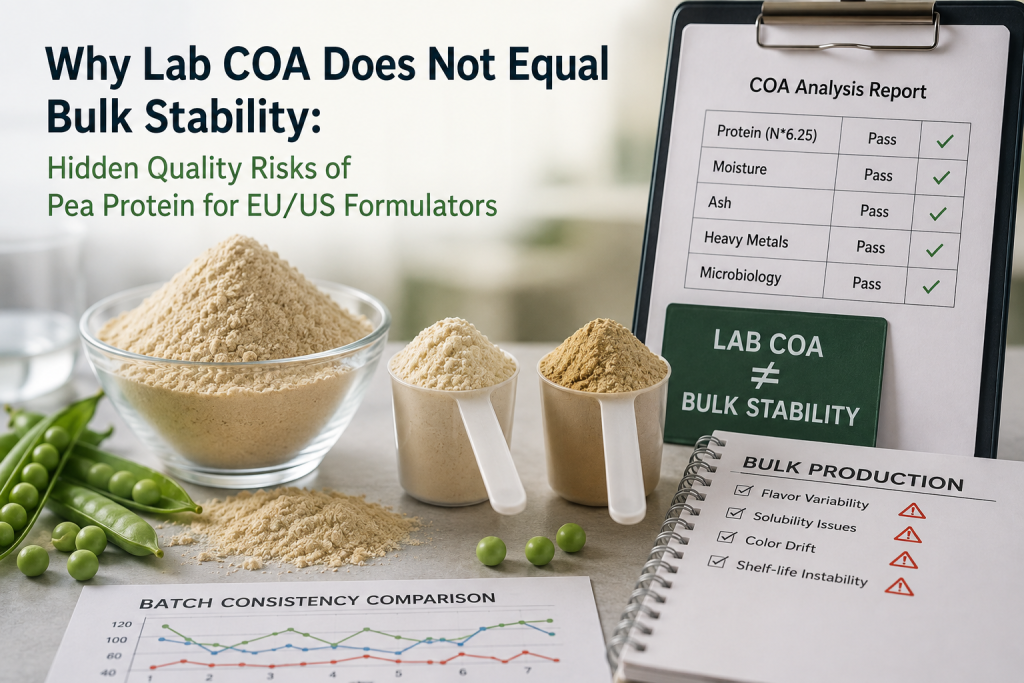
1. Key Pea Protein Bulk Stability Risks When Evaluating COA Reports
Factory COA tests are always based on optimized inspection samples, while commercial bulk production is affected by raw material seasonality, processing parameter fluctuations, and post-processing storage conditions.
- Raw material seasonal deviation: Yellow pea planting seasons, soil mineral content, and climate differences cause fluctuations in protein structure, fiber residue, and natural earthy flavor throughout the year.
- Production parameter drift: Industrial continuous production leads to slight changes in temperature, pH, and enzyme reaction time, affecting solubility and sensory performance.
- Post-production aging difference: Bulk powder undergoes compression, temperature changes, and long-distance shipping vibration, resulting in different stability compared with laboratory sealed samples.
Result: Qualified index data ≠ stable finished product performance.
2. Four Hidden Bulk Quality Risks That COA Cannot Reflect
2.1 Batch-to-batch flavor drift (the top complaint in the supplement industry)
Standard COA does not test sensory thresholds. Many pea protein batches show qualified protein purity and microbial data but present uncontrollable earthy, beany, or grassy off-flavor between batches. For clean-label products without strong flavor masking, tiny flavor differences will directly lead to inconsistent finished product taste.
2.2 Solubility attenuation during shelf life
Lab solubility tests are conducted on fresh powder. In actual storage and transportation, pea protein will have slow solubility decline and slight agglomeration due to moisture absorption and protein molecular rearrangement. This hidden risk often causes RTD beverage precipitation and powder dissolution failure after 2–3 months of shelf placement.
2.3 Color deviation and thermal discoloration
Bulk pea protein is more sensitive to temperature changes during ocean freight and warehouse storage. Long-term high-temperature environments will causeyellowing and color inconsistency, which cannot be detected by short-term laboratory testing.
2.4 Undetected cross-contamination and allergen risks
Many suppliers provide perfect non-GMO and allergen-free certificates, but cross-contamination occurs during bulk production line switching. For EU and US strict dietary supplement compliance, undocumented cross-contamination will lead to customs detention and market recall risks.
3. Seasonal Fluctuation Rules of Pea Protein Raw Materials
Professional purchasers clearly know that pea protein quality has obvious seasonal cycles:
- Harvest season (July–October): Fresh raw peas have low flavor intensity and stable solubility.
- Off-season (December–April): Inventory raw materials lead to increased residual beany flavor and slightly decreased solubility.
Excellent manufacturers will implement seasonal formula adjustment and flavor correction to ensure consistent year-round bulk performance, which is not reflected in ordinary supplier COAs.
4. Professional Buyer’s 7-Point Bulk Inspection Standard (Beyond COA)
High-end brands no longer judge quality only by laboratory indicators. The real bulk qualification standards include:
- Uniform color and no batch color difference
- Stable sensory threshold, no obvious off-flavor fluctuation
- Shelf-life solubility stability test (3-month simulation)
- Bulk density and powder fluidity consistency
- Heavy metal and pesticide residue batch traceability
- Production line allergen isolation records
- Shipping temperature resistance stability data
5. How to Avoid Bulk Failure in Pea Protein Sourcing
- Avoid judging quality only by index data: Prioritize factory batch stability control capability rather than single-sample test reports.
- Request seasonal stability reports: Professional suppliers can provide full-year batch comparison data.
- Conduct shelf-life simulation tests: Test solubility and flavor changes after 30/60/90 days of placement.
- Verify compliance traceability: Confirm batch-specific non-GMO, allergen, and pesticide control documents.
Conclusion
In the high-standard EU and US dietary supplement market, qualified COA is only the basic threshold, not the quality guarantee. The core competitiveness of premium pea protein lies in long-term batch stability, flavor consistency, and shelf-life performance controllability.
If you are looking for pea protein withstable bulk performance, zero batch fluctuation, and full EU/US compliance, contact us to obtain seasonal stability data, shelf-life test reports, and customized formulation technical support.