
As consumers continue to seek healthier lifestyles, the demand for sugar-free, reduced-sugar, and low-calorie foods is growing worldwide. Sugar alcohol sweeteners (also known as polyol sweeteners) have become essential ingredients in confectionery, beverages, bakery products, dairy products, and nutritional supplements.
However, no single sugar alcohol is perfect for every application. Each ingredient offers unique advantages in sweetness, texture, cooling effect, moisture retention, glycemic response, and processing performance.
In this guide, we’ll compare the nine most widely used sugar alcohol sweeteners, explain their differences, discuss their best food applications, and explore future industry trends.
What Are Sugar Alcohol Sweeteners?
Sugar alcohols are carbohydrates that provide sweetness while delivering fewer calories than sucrose. They are widely used in sugar-free and reduced-sugar formulations because they offer multiple functional benefits beyond sweetness, including moisture retention, bulking, freezing point control, and texture improvement.
The most common food-grade polyols include:
Xylitol
Maltitol
Sorbitol
Erythritol
Isomalt
Lactitol
Mannitol
Maltitol Syrup
Sorbitol Syrup
Each performs differently depending on the final product.
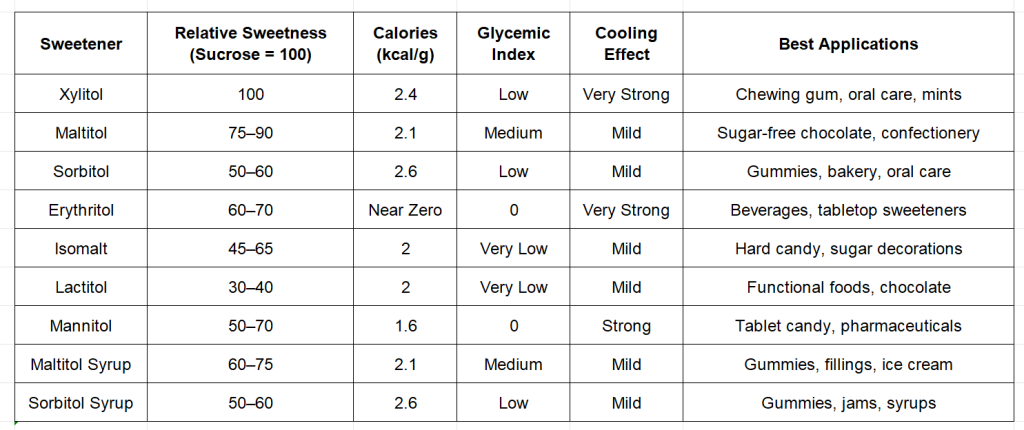
Comparison of Popular Sugar Alcohol Sweeteners
Understanding the Key Differences
1. Sweetness Profile
If your goal is to closely match the sweetness of sucrose, xylitol and maltitol are the best options.
Xylitol delivers nearly identical sweetness to sugar, making it ideal for chewing gum and sugar-free candies.
Maltitol provides a smooth sweetness without excessive cooling, making it the preferred sweetener for sugar-free chocolate.
Lower-sweetness ingredients such as sorbitol, isomalt, and lactitol are often blended with high-intensity sweeteners like stevia or monk fruit extract to achieve the desired sweetness level.
2. Calories and Glycemic Response
Consumers increasingly look for products with fewer calories and lower blood sugar impact.
Among all sugar alcohols, erythritol offers the lowest calorie content and a glycemic index of zero, making it popular in keto, diabetic-friendly, and low-carb products.
Isomalt, lactitol, sorbitol, and mannitol also have relatively low glycemic responses compared with sucrose.
Maltitol, while offering excellent taste, has a higher glycemic index than most other polyols and is therefore less common in products specifically targeting diabetic consumers.
3. Cooling Effect
One of the most noticeable differences among sugar alcohols is the cooling sensation.
The strongest cooling effect is provided by:
Xylitol
Mannitol
This characteristic works well in chewing gum, mint candies, and oral care products.
For chocolate applications, however, manufacturers often prefer maltitol because its mild cooling effect allows the chocolate flavor to remain rich and creamy.
4. Moisture Retention and Texture
Sugar alcohols contribute much more than sweetness.
Sorbitol and sorbitol syrup are excellent humectants that help retain moisture, extend shelf life, and improve chewiness.
For gummy candy manufacturers, sorbitol syrup has become one of the most important functional ingredients because it reduces crystallization while maintaining a soft texture throughout storage.
Maltitol syrup also performs exceptionally well in gummies, caramel, fillings, and ice cream by providing body and improving mouthfeel.
5. Processing Stability
Different food products require different processing characteristics.
For example:
Hard candy manufacturers often choose isomalt because of its excellent resistance to moisture absorption.
Mannitol performs well in compressed tablets due to its low hygroscopicity.
Sorbitol syrup enhances flexibility and chewiness in gummies.
Maltitol provides superior taste in chocolate formulations.
Selecting the right sugar alcohol often depends as much on processing requirements as on sweetness.
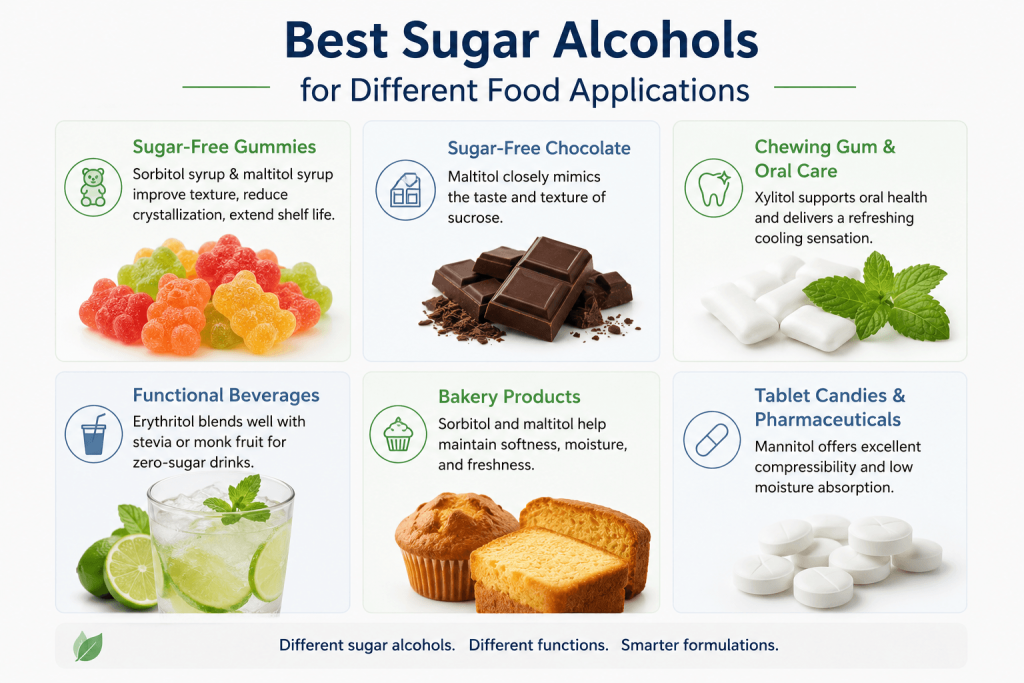
Best Sugar Alcohols for Different Food Applications
Choosing the appropriate polyol depends on the product category.
Sugar-Free Gummies
Sorbitol syrup and maltitol syrup are widely used because they improve texture, reduce crystallization, and extend shelf life. Many manufacturers also combine them with allulose or erythritol for reduced-sugar formulations.
Sugar-Free Chocolate
Maltitol remains the industry standard because it closely mimics the taste and texture of sucrose without introducing excessive cooling.
Chewing Gum and Oral Care
Xylitol dominates this category thanks to its tooth-friendly reputation and refreshing cooling sensation.
Functional Beverages
Erythritol is commonly blended with stevia or monk fruit extract to create clean-tasting, zero-sugar beverages.
Bakery Products
Sorbitol and maltitol help maintain softness and moisture while supporting sugar reduction goals.
Tablet Candies and Pharmaceuticals
Mannitol’s excellent compressibility and low moisture absorption make it a preferred ingredient.
Emerging Trends in Sugar Alcohol Sweeteners
The sugar reduction market is evolving rapidly, and manufacturers are changing their formulation strategies.
1. Blended Sweetener Systems Are Becoming the Standard
Instead of relying on a single sweetener, food developers increasingly combine multiple ingredients to improve taste, functionality, and cost efficiency.
Common combinations include:
Sorbitol Syrup + Allulose
Maltitol Syrup + Allulose
Erythritol + Monk Fruit Extract
Erythritol + Stevia
Sorbitol Syrup + High-Intensity Sweeteners
These blended systems deliver a more sugar-like taste while minimizing off-flavors and optimizing texture.
2. Functional Gummies Continue to Drive Demand
The global market for vitamin gummies, collagen gummies, probiotic gummies, children’s supplements, and sports nutrition gummies continues to expand.
As a result, demand for sorbitol syrup and maltitol syrup is expected to remain strong because both ingredients play a critical role in gummy processing and shelf-life stability.
3. Allulose Is Changing Sugar Reduction Formulation
Although allulose is not a sugar alcohol, it is becoming one of the fastest-growing sugar alternatives.
Compared with erythritol, allulose provides:
A sugar-like taste
Minimal cooling effect
Better browning performance
Improved texture
Excellent compatibility with bakery products
Many food manufacturers now combine allulose with traditional polyols to create next-generation sugar reduction solutions.
4. Clean Label and Better Consumer Experience
Today’s consumers expect more than lower calories.
They also want:
Better taste
Improved texture
Lower glycemic impact
Functional health benefits
This trend encourages manufacturers to develop customized sweetener systems rather than relying on a single ingredient.
Looking Ahead: The Future of Sugar Alcohol Sweeteners
Over the next five years, sugar alcohols will continue to play a vital role in food innovation. However, the market is shifting from single-ingredient solutions toward customized sweetener systems that combine polyols with rare sugars and natural high-intensity sweeteners.
Among traditional polyols, sorbitol syrup and maltitol syrup are expected to experience the strongest demand due to the continued growth of functional gummies and nutritional confectionery. Xylitol will remain the preferred choice for oral care products, while maltitol will continue to dominate sugar-free chocolate.
For food manufacturers, the future is no longer about replacing sugar with one ingredient—it is about designing balanced sweetening systems that deliver excellent taste, texture, processing performance, and nutritional value.
At Nihao Bio, we supply a comprehensive portfolio of high-quality sugar alcohol sweeteners, including xylitol, sorbitol, sorbitol syrup, maltitol, maltitol syrup, erythritol, isomalt, lactitol, and mannitol. Whether you are developing sugar-free gummies, confectionery, beverages, bakery products, or functional nutrition solutions, our technical team can help you select the right ingredient or customized sweetener blend for your formulation.
Looking for the ideal sweetener for your next product? Contact Nihao Bio today to request technical specifications, formulation support, or a free sample.