
Introduction: Why Black Carrot Powder Is Gaining Attention
The food and beverage industry is undergoing a significant shift toward natural colors, plant-based ingredients, and clean-label formulations. Consumers increasingly want products with recognizable ingredients and fewer artificial additives, while manufacturers are searching for natural alternatives that can still deliver bright, consistent, and appealing colors.
Among the growing range of natural food color sources, black carrot powder has attracted particular attention.
Despite its name, black carrot is not truly black. Its roots contain high levels of purple and red anthocyanin pigments, giving the plant its characteristic deep purple appearance. These pigments can provide a range of attractive shades—from bright red and pink to violet and purple—depending on the formulation.
For product developers, black carrot is interesting for another reason: its anthocyanins include a relatively high proportion of acylated anthocyanins, which can offer improved stability compared with some non-acylated anthocyanin sources.
However, black carrot powder is not simply a “natural purple color” that can be added to every formulation without further consideration.
Its performance depends on pH, temperature, processing, light exposure, oxygen, ingredient interactions, and storage conditions. Understanding these factors is essential when developing successful products with black carrot-derived colors.
What Is Black Carrot Powder?
Black carrot powder is produced from varieties of purple or black carrot (Daucus carota). Depending on the manufacturing process and intended application, the ingredient may be supplied as:
Whole black carrot powder
Black carrot juice powder
Black carrot concentrate powder
Black carrot extract
Anthocyanin-rich black carrot extract
These ingredients can differ significantly in composition and functionality.
For example, a whole vegetable powder may contain naturally occurring carbohydrates, fiber, and other components from the carrot. A standardized extract, on the other hand, may have a higher concentration of anthocyanins and stronger color intensity.
Therefore, when sourcing black carrot powder for food coloring, manufacturers should not evaluate products based on color alone. Important specifications may include:
Anthocyanin content
Color value or color strength
Water solubility
Particle size
Carrier ingredients
Moisture content
pH performance
Heat stability
Microbiological specifications
Heavy metal limits
The right material depends on the final food or beverage application.
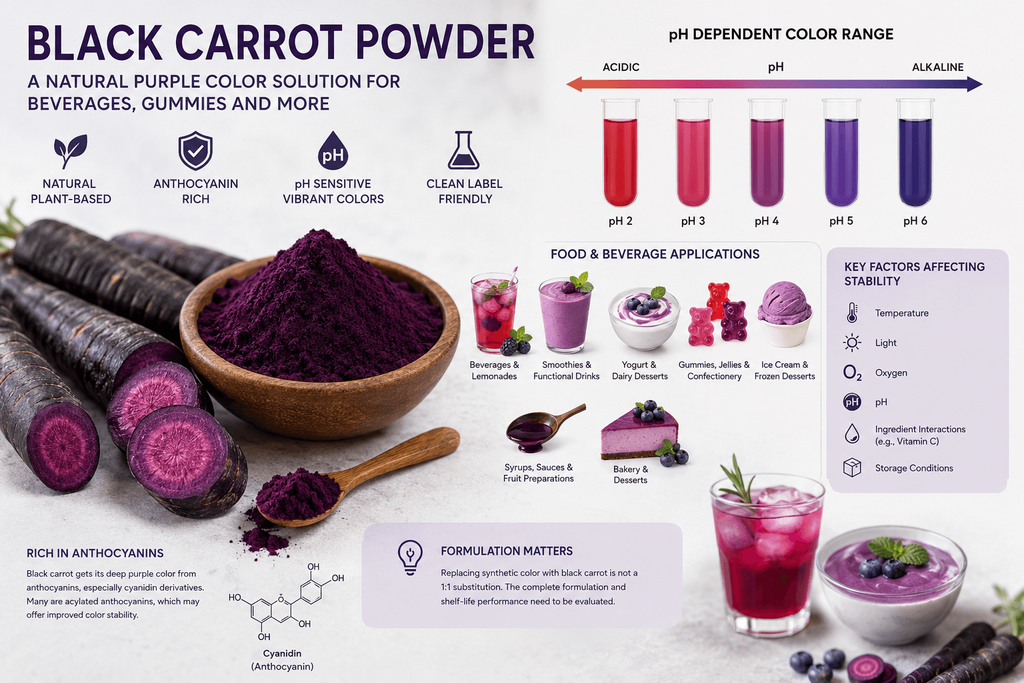
The Science Behind Black Carrot’s Purple Color
The characteristic color of black carrot comes primarily from anthocyanins, a group of naturally occurring plant pigments belonging to the polyphenol family.
The major anthocyanins in black carrot are primarily based on cyanidin derivatives.
One particularly important characteristic is that many black carrot anthocyanins are acylated. Acylation refers to the attachment of certain organic acid groups to the anthocyanin molecule.
From a food science perspective, this molecular structure can influence pigment behavior and may contribute to improved stability under certain conditions.
This is one reason why black carrot is often considered an attractive source of natural red, purple, and violet food color.
However, “more stable” does not mean “stable under all conditions.”
Natural pigments remain highly dependent on the complete formulation.
How pH Changes the Color of Black Carrot
One of the most important characteristics of black carrot anthocyanins is their pH sensitivity.
The same black carrot ingredient can appear dramatically different depending on the acidity or alkalinity of the product.
In acidic conditions, black carrot anthocyanins generally produce red, pink, or reddish-purple shades. As pH increases, the color may shift toward purple and violet, while stability and color intensity can also change.
This makes pH testing an essential part of product development.
A black carrot color that performs beautifully in a lemonade at a low pH may not produce the same appearance in a dairy product, gummy, or neutral beverage.
For this reason, manufacturers should evaluate black carrot colors directly in the final product system rather than relying only on a simple water test.
Typical Color Behavior
Depending on concentration and formulation conditions, black carrot-derived colors may produce:
Low pH: Red to pink shades
Moderately acidic systems: Red-purple to purple shades
Higher pH systems: Purple shades may change, weaken, or become less stable
The exact result will vary according to the specific black carrot ingredient and product matrix.
Applications of Black Carrot Powder in Food and Beverages
Thanks to its plant-based origin and attractive color profile, black carrot can be used in a wide range of food and beverage products.
1. Fruit Beverages and Lemonades
Acidic beverages are among the most promising applications for black carrot colors.
Fruit drinks, flavored waters, lemonades, juice drinks, and other acidic formulations can provide a suitable environment for producing bright red, pink, and purple shades.
Black carrot can be particularly interesting when developing:
Berry-flavored beverages
Grape beverages
Mixed fruit drinks
Lemonades
Functional drinks
Natural energy beverages
2. Smoothies and Functional Beverages
The growing functional beverage market creates new opportunities for natural colors.
Black carrot powder or extract can support visually appealing formulations containing ingredients such as plant extracts, vitamins, minerals, fiber, probiotics, or other functional components.
However, compatibility testing remains important because other ingredients can affect color stability.
3. Gummies, Jellies, and Confectionery
Black carrot color for gummies is an increasingly relevant application.
Natural purple and red shades can work well with fruit flavors such as:
Grape
Blackberry
Blueberry
Raspberry
Mixed berry
Blackcurrant
Cherry
The gummy manufacturing process, however, can involve heat, acid addition, moisture changes, and extended storage. Therefore, the timing of color addition and the complete processing conditions should be carefully evaluated.
4. Yogurt and Dairy Desserts
Black carrot can also be considered for yogurt, fermented dairy products, and dairy desserts.
In these systems, factors such as product pH, protein interactions, light exposure, and storage time should be evaluated.
The final shade may also be affected by the naturally opaque white background of the dairy matrix.
5. Ice Cream and Frozen Desserts
Frozen products offer another potential application.
Black carrot-derived colors can be used in fruit preparations, swirls, fillings, ice creams, and other frozen desserts.
However, freeze-thaw conditions and long-term storage should be included in stability testing.
6. Syrups, Sauces, and Fruit Preparations
Black carrot can provide attractive color in acidic fruit preparations, dessert sauces, syrups, and fillings.
It may be particularly suitable for products designed around berry and dark-fruit flavor profiles.
7. Selected Bakery Applications
Black carrot can be used in certain bakery and dessert applications, but heat stability must always be evaluated.
High baking temperatures and long processing times can significantly affect anthocyanin pigments. For some products, adding the color after high-temperature processing may be more practical.
Does Black Carrot Powder Offer Nutritional Benefits?
Black carrot contains anthocyanins, which are naturally occurring polyphenolic compounds.
Anthocyanins have been widely studied for their antioxidant properties and their potential biological activities related to oxidative stress and inflammatory processes.
However, an important distinction should be made between an ingredient’s composition and a finished product’s nutritional effect.
The presence of black carrot anthocyanins does not automatically mean that every purple-colored food or beverage provides a meaningful health benefit.
The actual nutritional contribution depends on factors such as:
Anthocyanin concentration
Serving size
Daily intake
Processing conditions
Bioavailability
Storage stability
The overall formulation
For food manufacturers, it is also important to distinguish between using black carrot as a coloring ingredient and making specific nutritional or health claims.
Product claims should always be evaluated according to the applicable regulations in the target market.
The Main Challenge: Anthocyanin Stability
One of the biggest challenges when using natural anthocyanin colors is maintaining consistent color throughout processing and shelf life.
Black carrot anthocyanins can be influenced by several factors.
pH
pH directly affects both the color shade and chemical form of anthocyanins.
Heat
Excessive heating or long thermal processing can contribute to pigment degradation.
Light
Light exposure during storage can cause color fading in certain products.
Oxygen
Oxidation can affect the stability of anthocyanin pigments.
Storage Temperature
Higher storage temperatures can accelerate degradation reactions.
Ingredient Interactions
Other ingredients in the formulation may either protect or destabilize anthocyanins.
Even ascorbic acid (vitamin C) can influence anthocyanin stability under certain formulation conditions.
This is particularly important for fruit beverages and functional drinks that contain both vitamin C and natural anthocyanin colors.
For this reason, a natural color replacement project should never be treated as a simple 1:1 substitution for a synthetic color.
A complete formulation and shelf-life study is often necessary.
Black Carrot Powder, Extract, or Concentrate: Which Is Best?
There is no single answer.
The best form depends on the application.
Black Carrot Powder
May be suitable when a dry ingredient format is preferred or when additional naturally occurring components are acceptable.
Black Carrot Extract
May offer higher color concentration and allow more precise dosing.
Black Carrot Concentrate
Can be suitable for certain liquid and semi-liquid food systems.
When selecting a material, manufacturers should consider not only the price per kilogram but also the effective color strength and dosage required.
A lower-priced ingredient may require a significantly higher addition level, while a more concentrated extract may provide stronger color at a lower dosage.
Therefore, the true cost should be evaluated based on the cost per unit of finished product—not simply the ingredient price.
How to Improve Black Carrot Color Performance
Successful use of black carrot powder requires a formulation-based approach.
During product development, consider the following factors:
Measure the final product pH.
Test multiple dosage levels.
Evaluate the color before and after processing.
Conduct accelerated and real-time stability studies.
Test under realistic light exposure.
Evaluate interactions with vitamin C and other active ingredients.
Conclusion: Black Carrot Is a Food Science Opportunity
Black carrot powder is more than just a natural purple food color.
It represents the intersection of plant-based ingredients, clean-label product development, natural color innovation, and food chemistry.
Its anthocyanin-rich composition can create attractive red, pink, purple, and violet shades, while its relatively high proportion of acylated anthocyanins makes it an interesting option for many food and beverage applications.
At the same time, successful formulation requires more than choosing an ingredient from a catalog.
pH, processing temperature, light exposure, oxygen, vitamin interactions, food matrix effects, packaging, and storage conditions can all influence the final result.
For food manufacturers developing the next generation of naturally colored beverages, gummies, dairy products, confectionery, and functional foods, black carrot powder and black carrot extract deserve careful consideration.
The key is not simply asking, “Can black carrot provide this color?”
The better question is:
“Can black carrot provide the right color—and maintain it throughout processing and the entire shelf life of our product?”
That is where ingredient selection, formulation expertise, and real-world stability testing come together.